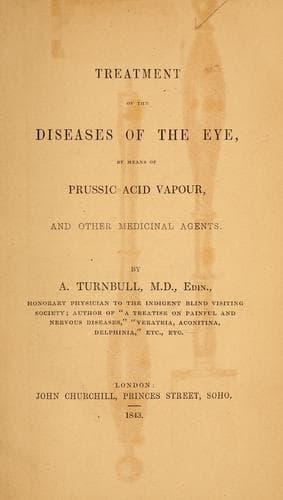
Treatment of the diseases of the eye, by means of prussic acid vapour, and other medicinal agents — John Shaqi
Treatment of the diseases of the eye, by means of prussic acid vapour, and other medicinal agentsTurnbull, Alexander
Science
Treatment of the diseases of the eye, by means of prussic acid vapour, and other medicinal agents
Turnbull, Alexander
Eye -- Diseases; Hydrocyanic acid -- Therapeutic use
SIR,--I beg leave to tender my sincerest thanks for your kind notice
in the last _Gazette_ of my recent discoveries on the treatment of
diseases of the eye, &c. Allow me to intrude for once in your crowded
columns, by referring to what you accidentally omitted--viz. the
manner of applying the _bisulphuret of carbon_, and also to add a
few reasons illustrative of the fact which you have quoted from me,
that its action depends on its union with the oxygen. The plan I
adopt is this:--I put a drachm of the bisulphuret of carbon into a
two-ounce bottle; the medicine is so volatile that the heat of the
hand causes the vapour rapidly to rise, and come into contact with the
skin. The action is more decided if the skin is previously moistened
with water; as the water not only prevents the escape of the vapour
between the glass and the skin, but also excludes the external air,
a point of the very highest importance. In my paper, which appeared
in the _Lancet_, of October 29th, I stated, that "when it had been
applied about one minute, the patient felt the part very cold, but
immediately after a gradual heat, accompanied with great prickling;
the heat increasing the longer the medicine was kept in contact with
the part, until it could no longer be endured. On removing the glass
the part was red, to an extent two or three times greater than the
part enclosed. These applications occasion no injury whatever to the
skin." Showing that the action of the bisulphuret of carbon depends on
its union with the oxygen in the blood-vessels, I will merely state
the following experiments:--Carbonic acid gas was applied in a similar
bottle, and in the same way, to the skin, the external air being
excluded, and the skin moistened with water, for the space of ten
minutes; but neither redness nor any sensible heat was induced; for
this satisfactory reason, that heat is the consequence of oxidation
with the carbon, which oxidation, in the case of carbonic acid gas,
had of course been previously effected. _Alcohol_, _sulphuric ether_,
_nitric ether_, and many other _ethers_--all of which contain a large
portion of carbon--were similarly tried, but had no effect; for the
same reason--viz. that it is already in a state of union with oxygen
in all these highly carbonized bodies.
I remain, Sir, your obedient servant,
A. TURNBULL, M.D.
CASE 1.
_Opacity of the Cornea, the sequel of Small-pox._
Public-domain text, read in full here on John Shaqi.
Reviews
Reviews
No reviews yet
Be the first to share your thoughts on this work.
Join the Discussion
Join the discussion
Sign in to leave a comment or review.
Sign InorCreate an account