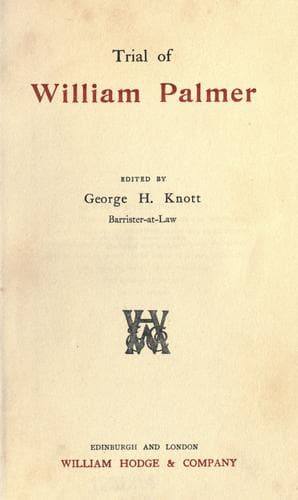
Cook, John Parsons, -1855; Palmer, William, 1824-1856 -- Trials, litigation, etc.; Trials (Murder) -- England -- London
Now, gentlemen, whether that be so or not will depend in a great degree,
as it strikes me--but, of course, it is entirely for you--on what you
think of the evidence of Elizabeth Mills; but before I go to the
evidence of Elizabeth Mills I will call your attention to what the
description of strychnia tetanus is, as given us by two very eminent
gentlemen who were called the other day for the Crown--Dr. Taylor and
Dr. Christison; and if we find on looking at it that that description of
the poison of strychnia tetanus, given by them, is a different thing
from the picture first given of the complaint, of the paroxysms of John
Parsons Cook by Elizabeth Mills and Mr. Jones, I think it would be
rather too bad on their mere opinion to say that this is strychnia
tetanus. Let us take Dr. Taylor’s description of strychnia tetanus--I am
not sure whether Dr. Taylor stated he had ever seen strychnia tetanus in
the human subject; however, we must be just to Dr. Taylor. Dr. Taylor
has had an extensive reading upon the subjects upon which he writes, and
it is not to be supposed that Dr. Taylor would hastily set down in his
book what he did not find established on high authority; therefore,
though having it at second hand, Dr. Taylor knows something upon the
subject.
[Sidenote: Serjeant Shee]
Now, Dr. Taylor, in his work on strychnia poison, has this under the
head of strychnia, “that from five to twenty minutes after the poison
has been swallowed the patient is suddenly seized with tetanic symptoms,
affecting the whole of the muscular system; the body becomes rigid, the
limbs stretched out, and the jaws so fixed that considerable difficulty
is experienced in introducing anything into the mouth.” On both the
depositions and the other evidence it is stated that Mr. Cook was
sitting up in bed, beating the bed-clothes, frequently telling the
people about him to go for Palmer, asking for the remedy, and willing to
take whatever was given him; there was no considerable difficulty in
introducing anything into the mouth, and the paroxysms, instead of
beginning within from five to twenty minutes after the poison was
supposed to have been swallowed, did not begin for an hour and a half
afterwards. Dr. Taylor further on states, “After several such attacks,
increasing in severity, the patient dies asphyxiated.” That there were
some of these symptoms in this case there can be no doubt, and there
will be some of them in every case of violent convulsions, yet it is not
the description of such a case as that of John Parsons Cook. Now, let us
see what Dr. Christison says--“The symptoms produced by strychnia are
very uncommon and striking--the animal begins to tremble, and is seized
with stiffness and starting of the limbs. Those symptoms increase till
at length the animal is attacked by general spasms.” Is that the
description of either of these paroxysms? Who can say with any degree of
truth that it is? Just observe these last indications of strychnia
Public-domain text, read in full here on John Shaqi.
Reviews
Reviews
No reviews yet
Be the first to share your thoughts on this work.
Elsewhere in the archive
Join the Discussion
Join the discussion
Sign in to leave a comment or review.
Sign InorCreate an account