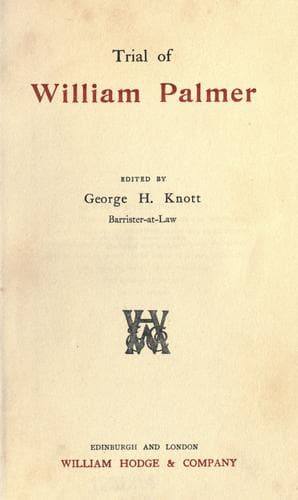
Cook, John Parsons, -1855; Palmer, William, 1824-1856 -- Trials, litigation, etc.; Trials (Murder) -- England -- London
tetanus, which are consistent with all the cases stated in their books.
It is only justice to those gentlemen who have taken pains to look to
the authorities to which they refer to say that the statements which
they give of their cases are in the main correct, but not in all their
details. The books would be five times their size if they were; but they
are in the main correct, when we look to the foreign authorities on
which they are founded--“The fit is then succeeded by an interval of
calm, during which the senses are impaired or are unnaturally acute; but
another paroxysm soon sets in, and then another and another, until at
last a fit occurs more violent than any that had preceded it, and the
animal perishes suffocated.” I know exactly what Dr. Christison means by
this, because there is a gentleman here who will state an experiment
which I saw myself; it was an experiment, and for the purpose of this
case, and to assist me; and I disagree with Dr. Taylor that there can be
a moment’s hesitation in sacrificing ten or twenty dogs for the purpose
of ascertaining the truth of this theory when a man’s life is involved.
These experiments were performed by Dr. Letheby while I was there. I
will state them to you, because he will prove it by and by. A dog had
some strychnia put in his mouth, one grain, and then for about--I cannot
be sure as to the time exactly, but about twenty or twenty-five
minutes--I cannot be sure, it might not be so much--the dog was
perfectly well. There were two rabbits on the table which were also
about to be subjected to the operation, and the dog, when the chain was
sufficiently relaxed to enable him to do so, showed all the indications
which a dog naturally does to get at the rabbits; he was pulling at his
chain, and was smelling and pawing and taking an interest in the
rabbits; suddenly it fell down on its side, and its legs were stretched
out in a most violent way. It panted, and then it remained for some
time--two or three minutes--quiet, occasionally a little jerking, but
generally quiet. It recovered again for a time, got up and looked at the
rabbits, but was dizzy, seemed afraid to move; and, if you touched it,
shuddered and twitched, to use Miss Elizabeth Mills’ description; seemed
to be afraid, and after another moment down it went again. It got up
again, and down it went again, and at last it had a tremendous struggle,
and it died. That is what Dr. Christison means by this description; it
would be true if the dose had been a strong one. If the dose had not
been sufficient to kill the dog it would probably be a longer time--at
least, I suppose so--in producing its effect, and the interval between
the paroxysms, as stated by Dr. Taylor and Dr. Christison, would get
longer and longer, until at last the animal would recover. If the dose
is strong enough to kill, the interval between the paroxysms is shorter,
till at last the violent one comes which destroys life; the eyes are
Public-domain text, read in full here on John Shaqi.
Reviews
Reviews
No reviews yet
Be the first to share your thoughts on this work.
Elsewhere in the archive
Join the Discussion
Join the discussion
Sign in to leave a comment or review.
Sign InorCreate an account