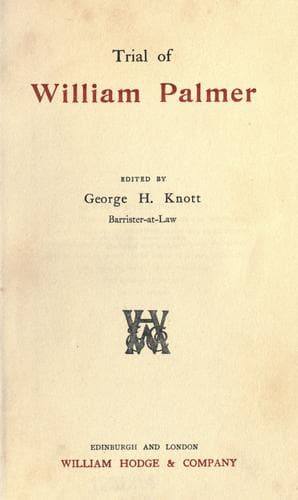
Cook, John Parsons, -1855; Palmer, William, 1824-1856 -- Trials, litigation, etc.; Trials (Murder) -- England -- London
Nevertheless, gentlemen, on the other hand, the case is not without its
difficulties; and I will not shrink from the discussion of them, nor
from the candid recognition of these difficulties, so far as they in
reality exist. Strychnia was not found in this body; and we have it, no
doubt upon strong evidence, that in a variety of experiments which have
been tried upon the bodies of animals killed by strychnia, strychnia has
been detected by the tests which science places at the disposition of
scientific men. If strychnia had been found, of course there would have
been no difficulty, and we should have had none of the ingenious
theories which gentlemen from a variety of parts have been brought
forward to propound in this Court. The question for your consideration
is, whether the absence of its detection leads conclusively to the view
that this death could not have been caused by the administration of that
poison. Now, in the first place, under what circumstances was the
examination made of which Dr. Taylor and Dr. Rees have spoken? They tell
you that when the stomach of this man was brought to them for the
purpose of analysis, it was presented to them under the most
unfavourable circumstances. They say that its contents had been lost,
and that they had no opportunity of experimenting upon them. It is very
true that those who put up the jar make a statement somewhat different.
They say that the contents of the stomach were emptied into the jar, but
there appears (at all events I will not put it higher than accident), by
accident, to have been some spilling of the contents; and there is, I
think, the clearest and most undeniable evidence of very considerable
bungling in the way in which the stomach was cut, and the way in which
it was emptied into the jar. It was cut from end to end, says Dr.
Taylor. It was tied up at both ends; it had been turned inside out into
the contents of the intestines, and lay there in a mass of fœculent
matter, and was therefore in a condition the most unsatisfactory for
analysis and experiment. It is very true that the witnesses upon the
other side--Mr. Nunneley, Mr. Herapath, and Dr. Letheby--say that, no
matter how contaminated or how mixed with impurities, they would have
been able to ascertain the presence of strychnia in the stomach, if
strychnia ever had been there. I own I should have more confidence in
the testimony of those witnesses if their partiality and partisanship
had not been so much marked as they are. I should have more confidence
in the testimony of Mr. Herapath if he had not been constrained to admit
to me a fact which had come to my knowledge, that he has again and again
asserted that this case was a case of poisoning by strychnia, but that
Dr. Taylor had not known how to find it out--he admits that that is a
statement he has again and again made.
Mr. SERJEANT SHEE--It was in the newspapers, he said.
[Sidenote: Attorney-General]
Public-domain text, read in full here on John Shaqi.
Reviews
Reviews
No reviews yet
Be the first to share your thoughts on this work.
Elsewhere in the archive
Join the Discussion
Join the discussion
Sign in to leave a comment or review.
Sign InorCreate an account