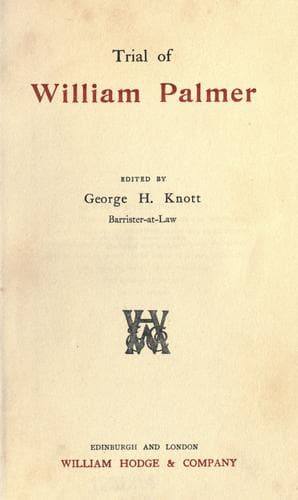
Cook, John Parsons, -1855; Palmer, William, 1824-1856 -- Trials, litigation, etc.; Trials (Murder) -- England -- London
Mr. ATTORNEY-GENERAL--He did not venture to say that the newspaper
statement in any way differed from the fact which he admitted in this
Court. I have seen that gentleman not merely contenting himself with
coming forward, when called upon for the purposes of justice, to state
that which he knew as a matter of science or of experiment, but I have
seen him mixing himself up as a thoroughgoing partisan in this case,
advising my learned friend, suggesting question upon question, and that
in behalf of a man whom he has again and again asserted he believed to
be a poisoner by strychnia. I do not say that alters the fact; but I do
say that it induces one to look at the credit of those witnesses with a
very great amount of suspicion. I reverence a man who, from a sense of
justice and a love of truth--from those high considerations which form
the noblest elements in the character of man--comes forward in favour of
a man against whom the world may run in a torrent of prejudice and
aversion, and who stands and states what he believes to be the truth;
but I abhor the traffic in testimony to which I regret to say men of
science sometimes permit themselves to condescend. I ask you therefore
to look at the statements of those witnesses with dispassionate
consideration before you attach implicit credit to them. But let me
assume that all they say is true, that it is the fact that they in their
experiments have succeeded in discovering strychnia when mixed with
other impurities, and contaminated, no matter by what cause--they say
that no extent of putrefaction, no amount of decomposition, will alter
the character of that vegetable matter, so that it may not be detected
if it is in the human stomach. Be it so. But then must it always be
found in every case where death has ensued? Professor Taylor says no;
and he says it would be a most dangerous and mischievous proposition to
assert that that must necessarily be so--that it would enable many a
guilty man to escape who, by administering the smallest quantity whereby
life can be affected and destroyed, might by that means prevent the
possibility of the detection of the poison in the stomach of the
individual. All the witnesses seem to agree in this, or, at all events,
the great bulk of them agree in this, that the poison acts after it has
been absorbed into the system; taken up by the absorbents of the
stomach, it is carried into the blood; passing by means of the
circulation through the tissues, it is deposited there; at some stage or
other of its progress it affects the nervous system; and as soon as the
nerves affecting the muscles of motion become influenced by its baneful
power, then come on those muscular spasms and convulsions of which we
have heard so much. If the minimum dose be given, and that operates by
absorption, it is perfectly clear--and must be clear--that the whole
must be taken up by absorbents and pass into the blood, and that none
therefore will be found in the stomach.
Public-domain text, read in full here on John Shaqi.
Reviews
Reviews
No reviews yet
Be the first to share your thoughts on this work.
Elsewhere in the archive
Join the Discussion
Join the discussion
Sign in to leave a comment or review.
Sign InorCreate an account