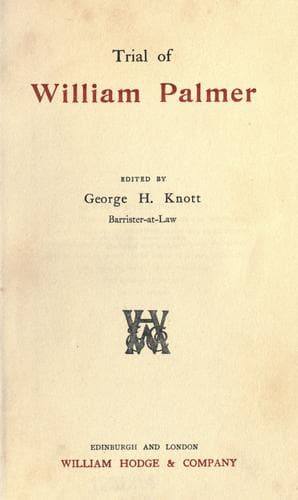
Cook, John Parsons, -1855; Palmer, William, 1824-1856 -- Trials, litigation, etc.; Trials (Murder) -- England -- London
bar went to Newton and obtained from him the fatal and deadly instrument
whereby life was to be destroyed, it is impossible that you can come to
any other conclusion than that the prisoner is guilty, and that your
verdict must pronounce him so.
What says my learned friend? He says that Newton does not speak the
truth--first, because he did not come forward till the last minute; and,
secondly, because he lays the time of his communication with the
prisoner, and affording him the strychnia, at nine o’clock, and the
prisoner was not in Rugeley until ten.
[Sidenote: Attorney-General]
Now, in the first place, I must remark upon this that the young man does
not say nine o’clock. He says, “about nine,” and every one knows how
easy it is to make a mistake as to time with reference to half an hour
or three-quarters of an hour, or even an hour, when your attention is
not till perhaps a week or a fortnight or three weeks afterwards called
to a particular circumstance. A man may be sitting working in his study
or his surgery, and have no clock before him, and have nothing
particular to impress upon his mind the precise hour of time at which a
certain transaction took place; and to say afterwards, when he comes to
speak to it under the sanction of an oath, that because he makes some
slight difference as to the time therefore he must be taken to be
speaking untruly, appears to my mind a most untenable and unsatisfactory
argument. It is due to my learned friend to say that he has sought to
meet this part of the case. He has produced to-day a witness of whom all
I can say is this, that I implore you, for the sake of justice, not to
allow the man who stands at the bar to be prejudiced by the evidence of
that most discreditable and unworthy witness who has been called to-day
on his behalf. I say that not to one word which that man has uttered
will you attach the slightest value. Before I come to him, however, I
must make this remark--that, if Newton could not be mistaken as to the
time, how is it possible that the prisoner could be mistaken as to the
time? Yet he clearly was. He told Dr. Bamford (and we have it from Dr.
Bamford himself) the next morning that he visited Cook between nine and
ten o’clock the night before. And now there comes a witness who tells us
that it was a quarter past ten that he had with him alighted from the
car that brought them from Stafford, and he could not till after that
have gone to visit Cook. My learned friend reminds me that it was ten
minutes past ten. Then he had to go to Cook. One of the maid-servants,
Lavinia Barnes, like every other witness, may be mistaken; but she
asserts that on that night, the Monday evening, Mr. Palmer came to the
hotel, and went to see Mr. Cook before nine o’clock. It is clear that
she must have been mistaken. It is clear that he could not have been
there much before ten. I am told that they get over in about an hour.
There was a carriage waiting for him, and he would come over to Rugeley
Public-domain text, read in full here on John Shaqi.
Reviews
Reviews
No reviews yet
Be the first to share your thoughts on this work.
Elsewhere in the archive
Join the Discussion
Join the discussion
Sign in to leave a comment or review.
Sign InorCreate an account