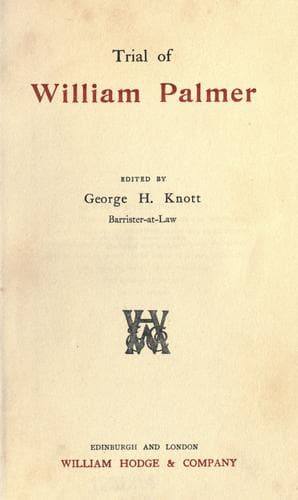
Cook, John Parsons, -1855; Palmer, William, 1824-1856 -- Trials, litigation, etc.; Trials (Murder) -- England -- London
with as much rapidity as he could, which would not be before ten
o’clock. As to the fact of the witness pretending that he saw him alight
from the car, and that he went to Cook and stayed a certain time so as
to cover the whole evening, I ask you not to believe a single word, and
I do so because in my heart I do not believe a single word of it.
[Sidenote: Attorney-General]
It is a remarkable fact, which has not escaped your attention, I dare
say, that my learned friend did not open a single word of the testimony
that he was going to call. He said he hoped and thought he should be
able to cover that whole period at Rugeley. Did he tell us what the
witness was going to prove, that Jeremiah Smith had been upstairs in the
inn, and seen by some of the people at the inn going upstairs to Cook’s
room? No, he did not. If he had we should have had plenty of time
between that and this to ascertain how the fact stood, and I believe
have been ready to meet Mr. Jeremiah Smith with contradictory evidence.
It was well to follow that course when you were uncertain what your
witness would say, or what your case might be, because you might be met
and confronted by contradictory evidence. I need not say that any
evidence would have been better than the evidence of that miserable man
whom we saw exhibited to-day. Such a spectacle I never saw in my
recollection in a Court of justice. He calls himself a member of the
legal profession. I blush for it to number such a man upon its roll.
There was not one that heard him to-day that was not satisfied that that
man came here to tell a false tale. There cannot be a man who is not
convinced that he has been mixed up in many a villainy which, if not
perpetrated, had been attempted to be perpetrated in that quarter, and
he comes now to save, if he can, the life of his companion and his
friend--the son of the woman with whom he has had that intimacy which he
sought to-day in vain to disguise. I say, when you look at the whole of
those circumstances, balance the evidence on both sides, and look at the
question of whether Newton can by any possibility have any motive for
coming here to give evidence which must be fatal to a man who, if that
evidence be not true, he must believe to be an innocent man--when you
see that he can have no motive for such a purpose--to suppose that he
would do so without a motive is to suppose human nature in its worst and
most repulsive form to be one hundred times more wicked and perverse
than experience ever yet has found it--I cannot but submit to you that
you ought to believe that evidence, and I cannot but submit to you
deferentially, but at the same time firmly and emphatically, that if you
do believe that evidence it is conclusive of the case.
[Sidenote: Attorney-General]
Public-domain text, read in full here on John Shaqi.
Reviews
Reviews
No reviews yet
Be the first to share your thoughts on this work.
Elsewhere in the archive
Join the Discussion
Join the discussion
Sign in to leave a comment or review.
Sign InorCreate an account