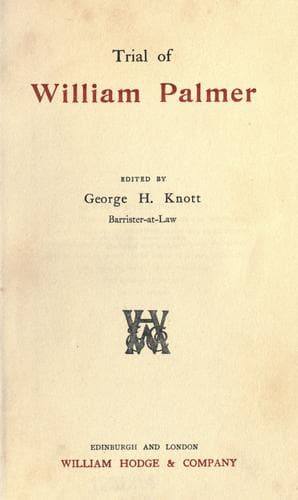
Cook, John Parsons, -1855; Palmer, William, 1824-1856 -- Trials, litigation, etc.; Trials (Murder) -- England -- London
But it does not stop there. On the morrow of that day we have the
clearest and most unquestioned evidence that Mr. Palmer bought more
strychnia. He went to Mr. Hawkins’ shop, and there purchased six grains
more, and the circumstances attending that purchase are peculiar in the
extreme. He comes to the shop, and he gives an order for prussic acid,
and, having got his prussic acid, he gives an order for strychnia.
Before the strychnia is put up, Newton, the same man, comes into the
shop. What does the prisoner do? He immediately takes Newton by the arm,
and says he has something particular to say to him, and takes him to the
door. What was it he had to say to him? Was it anything particular? Was
it anything of the slightest importance? Was it anything that might not
have been said in the presence of Roberts, who was putting up the
strychnia? Certainly not. It was to ask a most unimportant question,
namely, when young Mr. Salt was going to the farm which he had taken at
Sudbury. In that question there could be nothing which might not be put
in the presence of anybody, no matter who. He takes him to the door, and
then puts this question. At the same time a man of the name of
Brassington, a cooper, comes up, and Brassington had something to say to
Newton upon business, having some bills against Newton’s employer, Mr.
Salt. Upon that Brassington and Newton get into conversation at some
little distance from the door. The prisoner immediately takes advantage
of those two being in conversation, and he goes back and completes the
purchase of the strychnia. But while the strychnia was being made up he
stands in the doorway with his back to the shop, and his face to the
street, where he would have a perfect command of the persons of Newton
and Brassington, and where, if Newton had quitted Brassington to return
into the shop, the prisoner would at once have been in a position to
take every possible step for not letting Newton go in, by renewing the
conversation with him until the strychnia had been taken away. I ask
you, having this description of the transaction given to you by Roberts,
in the first place, confirmed by Newton afterwards, can you entertain
any reasonable doubt that the prisoner was desirous of not letting
Newton know that he was purchasing strychnia there? You can very well
understand that he would be desirous of keeping that fact from Newton,
because, if it be true that Newton had let him have three grains the
night before, Newton’s attention would be naturally immediately aroused
by so strange a circumstance, because nine grains of strychnia were
enough--three grains were enough--to kill three, perhaps six people.
What could a man want with nine grains of strychnia in so short a space
of time? It would attract Newton’s attention, and it did; for Newton
immediately went and asked what he wanted there, his attention being, in
the first place, directed, not so much to what he had come to purchase
Public-domain text, read in full here on John Shaqi.
Reviews
Reviews
No reviews yet
Be the first to share your thoughts on this work.
Elsewhere in the archive
Join the Discussion
Join the discussion
Sign in to leave a comment or review.
Sign InorCreate an account