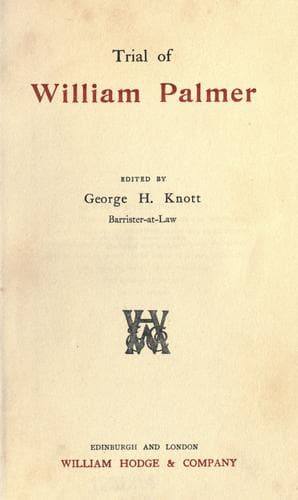
Cook, John Parsons, -1855; Palmer, William, 1824-1856 -- Trials, litigation, etc.; Trials (Murder) -- England -- London
But he is not satisfied with that--it is clear that he meditated another
fraud of a different description. On the Friday, almost as soon as the
breath is out of the man’s body, he intimates that he has a claim upon
him for £3000 or £4000 in respect of bills which had his (Palmer’s) name
or acceptance upon them, but which, in fact, had been negotiated for
Cook’s purposes. He tells the same story to the father-in-law, but it is
as clear as the sun at noonday that he endeavoured to fabricate an
instrument to give a show of colour to those representations. He goes on
the Thursday or the Friday to Mr. Cheshire, and brings to him a document
which he asks him to attest, that document bearing the signature “J. P.
Cook.” The man having left the body, and living only in the spirit
eight-and-forty hours before that signature had been brought to be
attested, who can fail to see that here was some great fraud and design
meditated? What was the document? It was a document which purported to
be an acknowledgment from Cook that certain large bills which had been
negotiated were for Cook’s benefit, and for Cook’s benefit alone, and
that he (Palmer) had had no part of the proceeds. Now, there are no such
bills in existence. We have exhausted the bills pretty well, I think,
and none such are proved to exist; but if there be any such bills in
existence, who would know it better than the prisoner at the bar? He
could have no difficulty in satisfying you of the fact, and of removing
this great stumbling-block in the way of his defence; but he produces
this document; and on the same day, the day that followed this poor
man’s death, he writes to Pratt, and says, “Mind, I must have ‘Polestar’
if it can be arranged.” What was this scheme? Having got every shilling
of the man’s money, his purpose was to secure the little property that
remained in “Polestar,” the value of which he may perhaps to himself
have considerably exaggerated. The mare had just won, and she might be
supposed to be worth more than she had been, or he had in view
speculating at other races to bring about results of benefit to himself.
Further, he may have intended to pay out of Cook’s estate some of those
bills, under the pretence that Cook had had the money for them. For all
these purposes, from the beginning to the end, it was necessary that
Cook should be put on one side. Then with this document in his hand he
goes to Cheshire, and he asks Cheshire to attest the signature of a man
who was then dead. If Cheshire had had the weakness and wickedness to
comply he would have had him in his power; and the next thing would have
been that he would have brought him trembling and reluctant into the
witness-box of some Court of justice to swear to the fact that he had
seen the dead man put his signature to that piece of paper. But it may
be suggested that, after all, the document was a genuine one, and that
the signature was not a forgery. Then produce it and we can judge. Here,
Public-domain text, read in full here on John Shaqi.
Reviews
Reviews
No reviews yet
Be the first to share your thoughts on this work.
Elsewhere in the archive
Join the Discussion
Join the discussion
Sign in to leave a comment or review.
Sign InorCreate an account