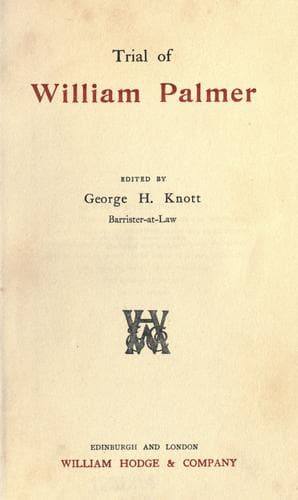
Cook, John Parsons, -1855; Palmer, William, 1824-1856 -- Trials, litigation, etc.; Trials (Murder) -- England -- London
again, I point out, and there is no escape from it, that the papers of
the prisoner were in his possession till the time of his arrest, and
they have been taken care of since then, and are here one and all,
either to be answered for or produced in his presence, or they have been
handed over to his brother. Who would not fail to notice that this paper
has never been found or asked for? Who can doubt that that paper brought
to Cheshire remained in the possession of the prisoner? Who can doubt
that it is either destroyed or is purposely withheld? Under these
circumstances who can doubt that in it is to be found proof of some
meditated act--of some vast design of a fraudulent and flagitious
character, for the full completion of which the death of Cook was a
necessary thing?
Now, gentlemen, I have gone through that part of the case which relates
to the motives of the prisoner, and it will be for you to say whether
you are satisfied that this was a death by strychnia--that the prisoner
was in possession of strychnia--that he had access to the dead man’s
bedside, and that he administered pills to him at a period short enough
to be capable of being connected with the catastrophe that afterwards
happened; and it will be for you to say whether you do not find that the
state of things with reference to pecuniary matters to which I have been
just alluding is sufficient to account for the act which is ascribed to
the prisoner.
[Sidenote: Attorney-General]
But there is another part of his conduct as throwing light upon this
matter to which I cannot fail to refer. What has become of Cook’s
betting book? What has been the conduct and the language of the prisoner
with reference to it? On the night when Cook died, ere the breath had
hardly passed from that poor man’s body, the prisoner at the bar was
rummaging his pockets and searching under his pillow. That may have
been for a perfectly legitimate purpose. But let us see what takes
place. He calls to Mr. Jones, and he tells Mr. Jones that it is his
duty, as the nearest friend of the dead man, to take possession of his
effects, and Mr. Jones does take possession of his watch, and
afterwards, at the suggestion of the prisoner, of his rings. At the same
time Mr. Jones asks for the betting book. My learned friend endeavoured
to explain away this most awkward part of the case by saying, “There
were other persons who had access to the place. The undertaker came
there with his men, the women came to lay out the dead body, and the
servants were there; any one of those might have stolen the book.” But
all this is met by the fact that, on that same night, before the women
had had anything to do in the room--before they came to lay out the
corpse--before anybody made their appearance--that very night, when Mr.
Jones is seeking to gather up the effects of the dead man, he asks for
the book. What is the answer? “Oh,” says Palmer, adopting the language
Public-domain text, read in full here on John Shaqi.
Reviews
Reviews
No reviews yet
Be the first to share your thoughts on this work.
Elsewhere in the archive
Join the Discussion
Join the discussion
Sign in to leave a comment or review.
Sign InorCreate an account