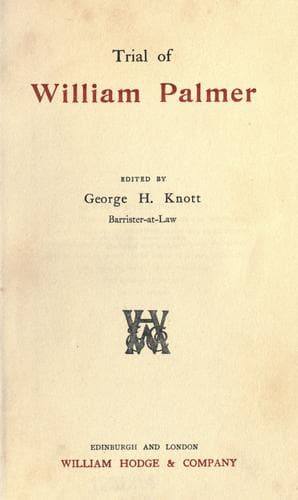
Cook, John Parsons, -1855; Palmer, William, 1824-1856 -- Trials, litigation, etc.; Trials (Murder) -- England -- London
Gentlemen, I will now in a few words give you the allegations upon the
one side and on the other. On the part of the prosecution it is alleged
that the deceased, John Parsons Cook, was first tampered with by
antimony, that he was then killed by strychnia, and that his symptoms
were the symptoms of poison by strychnia. It is then alleged that the
prisoner at the bar had a motive for making away with him; that he had
an opportunity of administering the poison; that suspicion fell upon no
one else; and that on two days, when the poison was supposed to have
been administered, he actually purchased strychnia, the poison
employed; and that, as they allege, his conduct before that transaction,
before the deed, while it was going on, and afterwards, was that of a
guilty, and not of an innocent, man. On the other side it is contended
(and you are to say whether or not truly contended) that the prisoner at
the bar was really the victim of prejudice; that he had no interest in
the death of the deceased; and, on the contrary, that the death of the
deceased was to his prejudice; further, that Cook did not die from
poison by strychnia, but from natural disease; that his symptoms were
those of natural disease, and not of poison by strychnia; and, further,
it is contended that no part of the evidence which has been given shows
anything which is at all consistent with the guilt of the prisoner.
Gentlemen, it is for you to determine between the allegations on the one
side and the other according to the evidence. A most anxious task is
imposed upon you, knowing that the life of the prisoner is at stake;
and, if you find him guilty, he must expiate his crime by an ignominious
death. It is of the last importance that you should be convinced of his
innocence or his guilt; and, if you are not convinced of his guilt, you
will rescue him from the fate with which he is threatened. On the other
hand, when you have heard the statements which were given in
evidence--if you are satisfied of his guilt--it will be your duty to
return a verdict of guilty; for if the poisoner were to escape with
impunity, there would be no safety for mankind, and society would fall
to pieces. Gentlemen, the burthen of proving the guilt rests on the
prosecution; and unless that is fully sustained, and you are not
convinced upon the evidence that he is guilty, then it will be your duty
to acquit the prisoner; but in a case of this kind you cannot expect
that witnesses should be called to state that they saw the deadly poison
administered by the prisoner or mixed up by the prisoner openly before
them. Circumstantial evidence as to that is all that can be reasonably
expected; and if there are a series of circumstances leading to the
conclusion of guilt, then, gentlemen, a verdict of guilty may
satisfactorily be pronounced. With respect to the alleged motive, it is
of great importance to see whether there was a motive for committing
such a crime, or whether there was not, or whether there is an
Public-domain text, read in full here on John Shaqi.
Reviews
Reviews
No reviews yet
Be the first to share your thoughts on this work.
Elsewhere in the archive
Join the Discussion
Join the discussion
Sign in to leave a comment or review.
Sign InorCreate an account