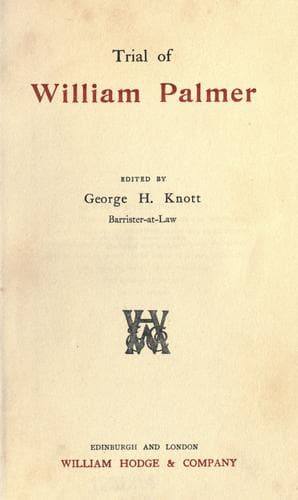
Cook, John Parsons, -1855; Palmer, William, 1824-1856 -- Trials, litigation, etc.; Trials (Murder) -- England -- London
improbability of its having been committed so strong as not to be
overpowered by positive evidence. But, gentlemen, if there be any motive
which can be assigned, I am bound to tell you that the adequacy of that
motive is of little importance. We know from the experience of criminal
Courts that atrocious crimes of this sort have been committed from very
slight motives, not merely from malice and revenge, but to gain a small
pecuniary advantage and to drive off for a time pressing difficulties.
It seems to me, gentlemen, you will have to consider well whether the
symptoms of Cook’s death are consistent with a poisoning by strychnia.
If they are not, if you believe that death arose from natural causes,
the prisoner is at once entitled to a verdict of not guilty at your
hands; but if those symptoms are consistent with a poisoning by
strychnia, then you will have another and an important question to
consider, whether the evidence which has been adduced is sufficient to
convince you that it was a death by strychnia, and by strychnia which
the prisoner administered. In cases of the sort the evidence has often
been divided into medical and moral evidence, the medical being that of
the scientific men, and the moral the circumstantial facts which are
calculated to prove the truth of the charge against the party accused.
Gentlemen, they cannot be finally separated in the minds of the jury,
because it is by combination of the two species of evidence that their
verdict ought to be found. In this case you will look at the medical
evidence to see whether the deceased, in your opinion, did die by
strychnia or by natural disease; and you will look at what is called the
moral evidence, and consider whether that shows that the prisoner not
only had the opportunity, but that he actually availed himself of that
opportunity, to administer to the deceased the deadly poison of which he
died.
Now, gentlemen, with these preliminary observations I will proceed to
read over to you the evidence which has been given in this long trial;
and I must implore you earnestly that, in any observations I may make
upon its effect, you will be guided only by your own judgment. To assist
you from time to time I may make observations, but you will not be in
the slightest degree influenced by them unless so far as your own
judgment concurs in them. The verdict must be yours, and in your hands
the life of the prisoner must rest.
[His lordship then began with and took the jury through the story of
Palmer’s financial transactions; next the evidence of Cook’s illness at
Shrewsbury; and then that of Elizabeth Mills and Lavinia Barnes, and of
Mr. Jones as to the illness at Rugeley; and passed to the evidence of
Newton.]
[Sidenote: Lord Campbell]
Public-domain text, read in full here on John Shaqi.
Reviews
Reviews
No reviews yet
Be the first to share your thoughts on this work.
Elsewhere in the archive
Join the Discussion
Join the discussion
Sign in to leave a comment or review.
Sign InorCreate an account