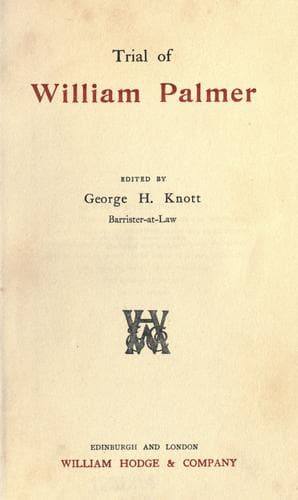
Cook, John Parsons, -1855; Palmer, William, 1824-1856 -- Trials, litigation, etc.; Trials (Murder) -- England -- London
Then, gentlemen, comes the more direct evidence that the prisoner at the
bar, if you believe the witnesses, procured this very poison on the
Monday and on the Tuesday--3 grains, I think, on the Monday, and 6 on
the Tuesday. For what purpose was that obtained? The evidence of the
witness who swears to the poison being obtained on the Monday is
impeached, but no impeachment rests upon the evidence of the witness who
swears to the poison being sold by him on the Tuesday to the prisoner at
the bar. You have no account of that poison; what was the intention with
which it was purchased, and what was the application of it, you are to
infer. Then, gentlemen, it is impossible that you should not pay
attention to the conduct of the prisoner at the bar, and there are some
instances of his conduct which you will say whether they belong to what
might be expected from an innocent or a guilty man. He was eager to have
the body fastened down in the coffin. Then, with regard to the betting
book, there is certainly evidence from which you may infer that he did
get possession of the betting book, that he abstracted it and concealed
it. Then, gentlemen, you must not omit his conduct in trying to bribe
the postboy to overturn the carriage in which the jar was being
conveyed, to be analysed in London, and from which evidence might be
obtained of his guilt. Again, you find him tampering with the
postmaster, and procuring from the postmaster the opening of a letter
from Dr. Taylor, who had been examining the contents of the jar, to Mr.
Gardner, the attorney employed upon the part of Mr. Stevens. And then,
gentlemen, you have tampering with the coroner, and trying to induce him
to procure a verdict from the coroner’s jury which would amount to an
acquittal. These are serious matters for your consideration, but you,
and you alone, will say what inference is to be drawn from them. If not
answered, they certainly present a serious case for your consideration.
It is for you to say whether the answer is satisfactory. Either you may
be of opinion that the case on the part of the prosecution is
insufficient, or you may be of opinion that the answer to it is
satisfactory.
Public-domain text, read in full here on John Shaqi.
Reviews
Reviews
No reviews yet
Be the first to share your thoughts on this work.
Elsewhere in the archive
Join the Discussion
Join the discussion
Sign in to leave a comment or review.
Sign InorCreate an account