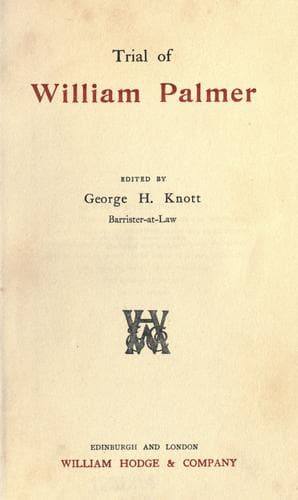
Cook, John Parsons, -1855; Palmer, William, 1824-1856 -- Trials, litigation, etc.; Trials (Murder) -- England -- London
Then, gentlemen, that answer consists of two parts--first, of the
medical evidence, and, secondly, of the evidence of facts. With regard
to the medical evidence, I must say that there were examined on the part
of the prisoner a number of gentlemen of high honour and solid integrity
and proved scientific knowledge, who came here only to speak the truth
and assist in the administration of justice. You may be of opinion that
others came whose object was to procure an acquittal of the prisoner.
Gentlemen, it is material, in the due administration of justice, that a
witness should not be turned into an advocate, any more than an advocate
should be turned into a witness. It is for you to say whether some of
those who were called on the part of the prisoner did not belong to the
category which I described as witnesses becoming advocates.
Gentlemen, the first witness on the part of the prisoner was Mr. Thomas
Nunneley. (The learned judge read the evidence of Mr. Nunneley and the
documents therein referred to.) You will recollect what he says, and you
will form your opinion as to the weight that is to be given to it. He
certainly seemed to me to give his evidence in a manner not quite
becoming a witness in a Court of justice, but you will give all
attention to the facts to which he refers in the evidence he gave. He
differs very materially in his general opinion from several of the
witnesses who were examined on the part of the prosecution. He speaks of
there being an extraordinary rigidity of the body after death, when
there has been a death of this description, with other symptoms, and he
attaches considerable importance to the heart being empty, but you will
say what weight ought to be attached to his opinion.
[Sidenote: Lord Campbell]
Mr. William Herapath is then called. (The examination-in-chief of Mr.
Herapath was read.) He seems to differ from Mr. Nunneley with respect to
the rigidity produced by this poison. Now, gentlemen, Mr. Herapath is a
very skilful chemist, and I have no doubt he spoke sincerely what he
thought, and what was his opinion? That when there has been death by
strychnia, strychnia ought to be discovered; but it seems he intimated
an opinion on this very case of Cook that there might have been
strychnia, and that Dr. Taylor did not use the proper means to detect
it. Now, the only evidence that we have in this case that there was not
strychnia is the analysis by Dr. Taylor and Dr. Rees that they did not
discover it. As I before pointed out to you, in two other cases in which
there certainly had been poisoning by strychnia the result was the
same--they could not discover it.
Public-domain text, read in full here on John Shaqi.
Reviews
Reviews
No reviews yet
Be the first to share your thoughts on this work.
Elsewhere in the archive
Join the Discussion
Join the discussion
Sign in to leave a comment or review.
Sign InorCreate an account