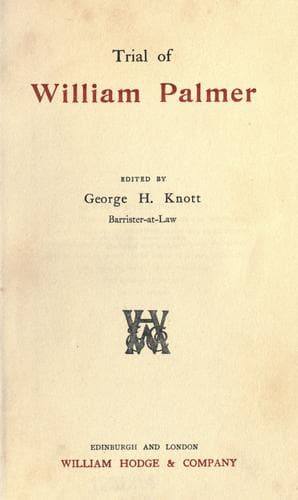
Cook, John Parsons, -1855; Palmer, William, 1824-1856 -- Trials, litigation, etc.; Trials (Murder) -- England -- London
After a struggle with internal emotions too dreadful to be described,
amid the tears and lamentations of my family, the bereavement of a
household knit together in bonds of strongest love and amity, and the
smothered, not wholly-concealed indignation of relatives and friends, I
address your lordship, not only as the man who has sealed my brother’s
fate and borne him to the foot of the scaffold, but as the judge who
will have to render an account to your fellow-men, to posterity, and to
God of your dealing towards a human being whose fate was, to a certain
extent, placed in your hands, and on whose destiny you operated in a
manner hitherto unknown, at least in our days. The law, with bitter
irony, propounds it is an axiom dear to Englishmen that a magistrate
invested with powers like your lordship is “counsel for the prisoner”;
but every man who witnesses the late mockery at the Old Bailey, in which
you played so prominent a part, confesses--to his own heart, at least,
whatever he may own in public--that a more infamous delusion has never
been solemnly enacted before a British audience since those days of
shame when Jeffreys went forth upon the “bloody assize,” and, in the
name of Justice and the Law, consigned the young, the innocent, the
helpless, and the stricken with years to the dungeon and the gallows,
professing all the while to be actuated by a sense of duty to the Crown
and to the people.
These may appear strong words, and this a heavy accusation, but I will
demonstrate it to all who read this letter. What though I may not hope
to move your lordship to justice, yet I may, at least, awaken within you
a sense of that awful day which approaches you as certainly as it looms
on my brother, and which, at your advanced age, cannot be far removed. I
may awaken within you a feeling of compunction, or, at all events, of
solemn reflection; for you, also, will have to stand before a Judge
enthroned in majesty and power; before whom you will be, indeed, as
nought; and when upon your brow appears the awful record of your
administration of justice to the man whom you have condemned, in that
hour also shall you remember this word from the brother of his
affections. May it avail you before that terrific moment! May it serve
to save yourself from yourself, and to warn you in time that it is the
duty of a British judge to hear, not to condemn; to adjudicate, not to
execute; to administer the law as the representative of the country, not
to pervert it to his own purposes with the anxiety of a hangman.
Public-domain text, read in full here on John Shaqi.
Reviews
Reviews
No reviews yet
Be the first to share your thoughts on this work.
Elsewhere in the archive
Join the Discussion
Join the discussion
Sign in to leave a comment or review.
Sign InorCreate an account