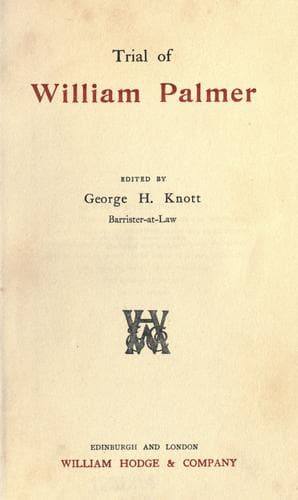
Cook, John Parsons, -1855; Palmer, William, 1824-1856 -- Trials, litigation, etc.; Trials (Murder) -- England -- London
My lord, in one week--in some short days from this--William Palmer, my
brother, will stand before his God; he will have to answer for his life,
and for the sins of his life; he will have to endure that fearful
scrutiny into his past from which even the best of us may well shrink
with terror. But there is one crime for which he will not have to
answer, and that is the crime for which your lordship has convicted him.
My brother, William Palmer, is no murderer. His whole life, his whole
character, his whole bearing at and since the trial are quite convincing
of the fact. From childhood upward no man was gentler of heart; his
charity was inexhaustible; his kindliness to all who were in distress
was well known. To him the wanderer resorted in his afflictions; by him
the poor and houseless were fed and comforted. I write in the face of
the public, with my character as a gentleman and a clergyman at stake,
and I avow only facts that cannot be denied. His liberality was a
proverb, his frank sincerity, his courage, his faithful loyalty to his
friends, his temperance, his performance of the duties of religion, his
social relations in the character of father, husband, and son won for
him the love and confidence of all who approached him; and though it is
true that in one fatal instance he violated the laws of his country, and
subjected himself to a severe penalty for an infringement of its
commercial code, yet this excepted, his was in all respects the very
opposite of that cool, calculating, cowardly, crafty temper which is
essential to the poisoner, and which we know cannot co-exist with these
qualities which my brother possessed from his earliest years down even
to the day when your lordship sent him to his death. My lord, beware,
lest while you convict of murder you are not yourself a party to a
murder! It is not the first time that the annals of our own
jurisprudence have exhibited traces of blood; it is not the first time
that judges have persuaded juries to convict to death on circumstantial
evidence. The records of every country abound in remarkable cases of
persons judicially destroyed for crimes of which they were entirely
innocent. A mistaken resemblance to the actual perpetrator, the fact of
having been seen near the spot where the crime was committed, an
apparent motive of self-interest, a confusion of manner when he was
accused, or some other suspicious circumstance has contributed to bring
the odium of guilt and consequent punishment on the wrong party. At one
time cases of frightful injustice were committed by condemning
individuals for murder when it was not proved that a murder had been
perpetrated. The now well-recognised principle in criminal
law--violated, indeed, by your lordship in my brother’s case--that no
murder can be held as having been committed till the body of the
deceased has been discovered, had, apparently, terminated this form of
legal oppression until your lordship persuaded a jury to find a man
Public-domain text, read in full here on John Shaqi.
Reviews
Reviews
No reviews yet
Be the first to share your thoughts on this work.
Elsewhere in the archive
Join the Discussion
Join the discussion
Sign in to leave a comment or review.
Sign InorCreate an account