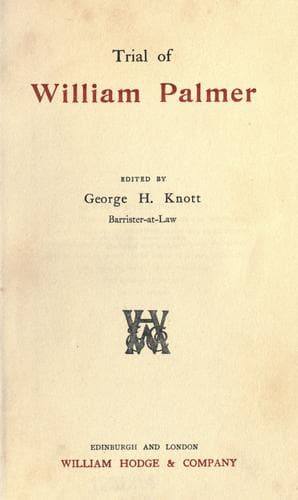
Cook, John Parsons, -1855; Palmer, William, 1824-1856 -- Trials, litigation, etc.; Trials (Murder) -- England -- London
guilty of blood where there was no actual positive proof that a homicide
had at all been perpetrated, and when the chemical analysis had even
demonstrated that it had not. Another, and perhaps one of the most
common causes of prejudice in trials of this nature was the
prevarication or the suspicious conduct of the party charged with the
offence, and this, likewise, your lordship told the jury was proof of my
brother’s guiltiness. Finding himself, though innocent, placed in an
awkward predicament, the accused sometimes invented a plausible story in
his defence, and the deceit being discovered, he was at once presumed to
be in every respect guilty. Sir Matthew Hale mentions a melancholy
instance of this kind. An uncle, who had the bringing up of his niece,
to whom he was heir-at-law, correcting her for some offence, she was
heard to say, “Good uncle, do not kill me!” after which she could not be
found. The uncle was committed on suspicion of having murdered her, and
was admonished by the judge of the assize to find out the child by the
next assizes. Being unable to discover his niece, he brought another
child, dressed like her, and resembling her in person and years; but, on
examination, the fraud was detected, and upon the presumption of guilt
which those circumstances afforded, he was sentenced to be hanged, and
the sentence was executed. The child afterwards reappeared, when of age,
to claim her land. On being beaten by her uncle she had run away, and
had been received by a stranger; a jury, worked upon by suspicion, and
probably also by a judge who pandered then, as judges pander now, to
public prejudice, had thus murdered an innocent man; and that great
Chief-Justice has preserved the fact as a warning for all time to beware
of judgment in cases of life and death. Yet your lordship, who has
succeeded that noble luminary of the law, forgot this memorable case in
the moment when you ought most to have remembered it; though I take upon
myself to say the circumstantial evidence against my brother was not
half as powerful as that against this gentleman whose fate has thus been
commemorated in vain by your lordship’s wise and Christian predecessor
in the judgment seat. Yet do I believe that, as surely as the sun shines
or that God lives in the heavens, there will come a day when my
brother’s innocence will be demonstrated before all men, and though your
lordship may not live to see it, yet will his blood cry out from his
prison grave, and his fate will blacken the memory of all who were
parties to his death with immortal infamy. For it is at your door the
public will lay his conviction--not at that of the jury who were worked
upon to convict, and who would have been more than men if they had
resisted your looks, your gestures, your actions, and your arguments. My
lord, since this conviction of death has been recorded I have seen
William Palmer. I have visited him in his condemned hold. I have beheld
Public-domain text, read in full here on John Shaqi.
Reviews
Reviews
No reviews yet
Be the first to share your thoughts on this work.
Elsewhere in the archive
Join the Discussion
Join the discussion
Sign in to leave a comment or review.
Sign InorCreate an account