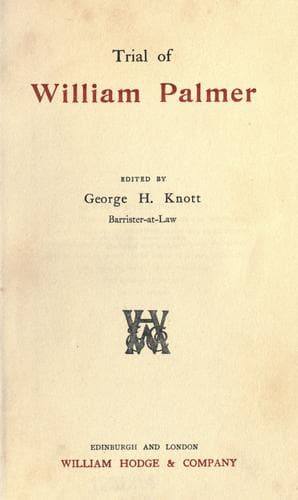
Cook, John Parsons, -1855; Palmer, William, 1824-1856 -- Trials, litigation, etc.; Trials (Murder) -- England -- London
(Evidence was given to show that Herring held three bills of exchange,
each for £200, on which Cook and Palmer were jointly responsible to him.
He received £200 from Cook on one bill; another £200 bill he deducted,
as instructed by Palmer from the £1000. The third bill he paid himself
for by not paying Padwick as Palmer instructed him. Besides these bills
Herring held a fourth for £500 drawn by Palmer on his mother, and
endorsed by him and Cook. It was proved that this acceptance was not in
Mrs. Palmer’s handwriting.)
The Court then adjourned.
Fourth Day, Saturday, 17th May, 1856.
The Court met at ten o’clock.
[Sidenote: George Bate]
GEORGE BATE, examined by Mr. JAMES--I am a farmer, and was in the
employment of the prisoner during September, October, and November of
last year. I was engaged to look after his horses, and received no
stated salary, sometimes two sovereigns and sometimes one sovereign a
week. I remember in the month of September, 1856, being in the company
of Mr. Cook and Mr. Palmer. Something was said by one of them to me
about an insurance being proposed on my life.
Mr. SERJEANT SHEE objected to this evidence, and his objection was
sustained.
* * * * *
[Sidenote: T. B. Curling]
Mr. THOMAS BLIZZARD CURLING, examined by the ATTORNEY-GENERAL--I am a
Fellow of the College of Surgeons, and surgeon to the London Hospital. I
have published a work on the subject of tetanus. Tetanus signifies
spasmodic affection of the voluntary muscles of the body. There are two
sorts of tetanus, idiopathic and traumatic. Idiopathic tetanus is
tetanus originating, as it were, as a primary disease, without any
wound. Traumatic is from a wound. During twenty-two years I have been
surgeon to the London Hospital. I have never seen a case of idiopathic
tetanus. I have seen over fifty cases of traumatic tetanus. Traumatic
tetanus first manifests itself by a stiffness about the jaws and the
back of the neck; rigidity of the muscles of the abdomen usually sets
in; a dragging pain at the pit of the stomach is almost a constant
attendant of spasm of the diaphragm, and in many cases the muscles of
the back are sensibly affected. Then the spasms, though continuous, are
liable to aggravation in paroxysms. As the disease goes on these
paroxysms become more frequent and more severe. When they occur, the
body is drawn backwards; in some instances, though less frequently, it
is bent forwards; then, in an acute case, a difficulty in swallowing is
a very common thing; a difficulty in breathing also during the paroxysm,
a choking sensation. The disease may end, supposing it be fatal, in two
ways; the patient may die somewhat suddenly of suffocation, owing to
closure of the opening of the windpipe, or the patient may be worn out
by the severe and painful spasms, and the muscles may relax and the
patient gradually sink and die. Traumatic tetanus is generally fatal,
and the locking of the jaw is an almost invariable symptom.
Public-domain text, read in full here on John Shaqi.
Reviews
Reviews
No reviews yet
Be the first to share your thoughts on this work.
Elsewhere in the archive
Join the Discussion
Join the discussion
Sign in to leave a comment or review.
Sign InorCreate an account