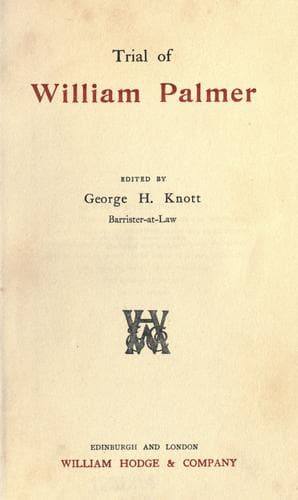
Cook, John Parsons, -1855; Palmer, William, 1824-1856 -- Trials, litigation, etc.; Trials (Murder) -- England -- London
A symptom
very characteristic of the disease is a contracted condition of the
eyelids, a raising of the angles of the mouth, and a contraction of the
brow. The lower extremities are sometimes affected, and sometimes the
upper; the muscles affected are chiefly those of the trunk. I have never
heard of traumatic tetanus being produced from sore throat or from
chancre. A case of traumatic tetanus which ends fatally takes from one
day to four days, or longer, before death ensues. I never heard of a
case in which a man would be attacked one day and then have twenty-four
hours’ respite, and be again attacked the next. The symptoms of the
death of Mr. Cook, given by Mr. Jones, the surgeon, were not consistent
with any form of traumatic tetanus I ever heard of. There was the sudden
onset of the fatal symptoms; in all cases that have fallen under my
notice the disease has been preceded by the milder symptoms of tetanus.
The symptoms given by the woman Mills as to the Monday night were not
those of tetanus. The sudden onset and rapid subsidence are not
consistent with what I call the true form of tetanus. The poison, nux
vomica, produces tetanic convulsions.
Cross-examined by Mr. SERJEANT SHEE--Any irritation of the nerves
proceeding to the spinal cord might produce tetanus. I agree with Dr.
Watson in his “Lectures on the Principles and Practice of Physic,” that
all the symptoms of tetanic convulsions may arise from such slight
causes as the sticking of a fish bone, the mere stroke of a whip lash
under the eye, from the cutting of a corn, from the bite on the finger
by a tame sparrow, from the extraction of a tooth, from the operation of
cupping, and simple things of that character. Idiopathic tetanus would
not be so likely to bring the patient to the hospital as a sudden wound
leading to traumatic tetanus. A syphilitic sore would not be likely to
lead to tetanus.
Re-examined by the ATTORNEY-GENERAL--A medical practitioner who saw a
case of convulsions would be able at once to know the difference between
symptoms of general convulsions and of tetanus. One of the
characteristic features of tetanus is that the consciousness is not
affected.
* * * * *
[Sidenote: Robert Todd]
Public-domain text, read in full here on John Shaqi.
Reviews
Reviews
No reviews yet
Be the first to share your thoughts on this work.
Elsewhere in the archive
Join the Discussion
Join the discussion
Sign in to leave a comment or review.
Sign InorCreate an account