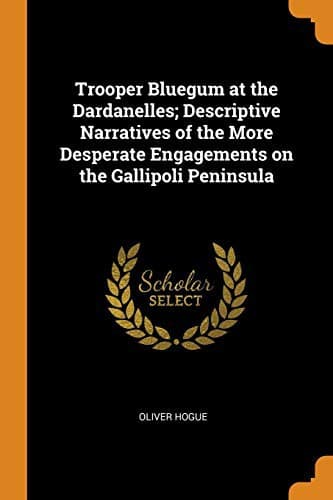
Trooper Bluegum at the Dardanelles: Descriptive Narratives of the More Desperate Engagements on the Gallipoli Peninsula — John Shaqi
Trooper Bluegum at the Dardanelles: Descriptive Narratives of the More Desperate Engagements on the Gallipoli PeninsulaHogue, Oliver
History
Trooper Bluegum at the Dardanelles: Descriptive Narratives of the More Desperate Engagements on the Gallipoli Peninsula
Hogue, Oliver
World War, 1914-1918 -- Campaigns -- Turkey -- Gallipoli Peninsula; World War, 1914-1918 -- Personal narratives, Australian
One or two other bonfires were started. The native police rolled up and
kept the crowd back, one of the police inspectors remarking that it
would be a good thing for Cairo if a few more of the "dens" were burned
down. "I've been wishing for a fire among these rotten tenements for a
long time," he said, "and now the fire-engines are coming, and it looks
as if they'll be saved again!"
The fire-engine came clattering up the street. The soldiers raided it.
In self-defence the firemen repelled the attack with the fire-hose.
The soldiers renewed the attack and, reinforcements having arrived,
captured the hose and turned it on the firemen, completely routing
them. Then they cut the hose up--and the Maoris went on with their
"haka."
But in the end, of course, law and order had to prevail. Other engines
came upon the scene, escorted by a squadron of Territorial Dragoons.
The soldiers cooled down. The fires were put out. There's a lot more
about this battle of the Wazir, but I cannot tell it.
Not creditable, of course. Not quite the sort of thing they had been
sent there for. But human nature is human nature, and a crowd of
soldiers is a crowd of soldiers, and bad grog will make the best of
soldiers bad, especially in Cairo; and the evil that's in men must
come out of them as well as the good. Hence to call the Maoris
"niggers"--well, who can blame the New Zealanders for resenting it,
and who can blame the Australians for siding with the New Zealanders,
or the Territorials for assisting their Oversea brethren, when we have
Mr. Asquith's own word for it that "Who touches them touches us"? Not
creditable!--but human nature--British brotherhood! And high spirits,
and the chafing under the monotony of camp life in Egypt! Trooper
Bluegum, at all events, long ago forgave them. The same men were among
those who were to create for themselves and their country, in the
words of General Ian Hamilton, "An imperishable record of military
virtue." Many of them are no more. Maoris and all have given their
lives cheerfully for their Empire and the sacred cause of Right. Let us
remember their virtues and forget their faults.
There came a day when there was sudden movement in the camp. General
Birdwood had arrived--one of Kitchener's "hard riding" generals, with a
wonderful string of medals and decorations--and there were other "signs
of the zodiac" pointing to our early departure. When at last, at the
"Stadium," Colonel Ryrie announced to us of the 2nd Light Horse that
we were to make ready, you could have heard the cheering miles away.
The residents of Ma'adi, when they heard it, thought peace had been
declared!
Public-domain text, read in full here on John Shaqi.
Reviews
Reviews
No reviews yet
Be the first to share your thoughts on this work.
Join the Discussion
Join the discussion
Sign in to leave a comment or review.
Sign InorCreate an account