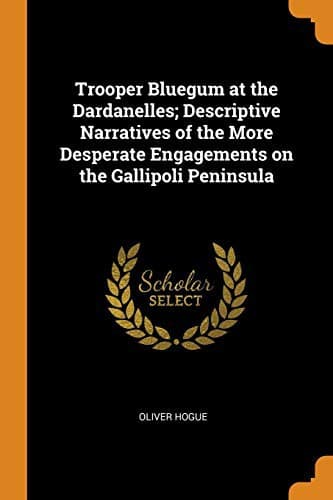
Trooper Bluegum at the Dardanelles: Descriptive Narratives of the More Desperate Engagements on the Gallipoli PeninsulaHogue, Oliver
History
Trooper Bluegum at the Dardanelles: Descriptive Narratives of the More Desperate Engagements on the Gallipoli Peninsula
Hogue, Oliver
World War, 1914-1918 -- Campaigns -- Turkey -- Gallipoli Peninsula; World War, 1914-1918 -- Personal narratives, Australian
What a terribly expensive business it was all to be! How many brave
Australians and New Zealanders--yes, and Englishmen, Frenchmen and
Indians--were yet to be sacrificed! It is well that the Great Ruler
over all, Who holds us in the hollow of His hands, does not permit poor
mortals to see into the future. The "forcing of the Dardanelles"--the
words were on the lips of all of us and were printed in newspapers all
over the world--it seemed only a matter of a little while, and then----
Great is the British Navy, magnificent are its officers and men, but
hellish was the work of "forcing the Dardanelles." You remember how
the _Goliath_ and the _Irresistible_ went down. You remember how a
great French ship--the _Bouvet_--was sunk. You remember the mines that
came down the waters, and the shore torpedoes, and the strength of
the Turkish forts, the power of the Turkish guns, erected and manned
by German officers. The Navy could not force the Dardanelles alone!
It was necessary to have the co-operation of land forces. Perhaps the
operations should never have been begun until the Army was ready to
co-operate. I do not know; it is not for me to judge.
General Sir Ian Hamilton first visited the Dardanelles and carried
out a reconnaissance on one of the warships and then came to Egypt--a
lightning visit--and our forces began to move. Australia, for the first
time, was right up against the Hun! South Africa was a picnic to it.
There were spies everywhere. There were spies in the transports, spies
amongst the interpreters, spies in the supply depots. The Turks, or
rather their German officers, were kept informed of every move the
Allies made. They knew exactly the hour of disembarkation and the
places of landing. They learned all the Australian bugle calls and used
them with telling effect. The French landed and formed up as if on
parade, and then, with beautiful precision, marched on and drove the
enemy before them. The British, despite the fusillade which greeted
them on landing, were steady as veterans and there was no hope of
withstanding their landing.
But there was an electric quality about the charge of the Australians
that inspired panic in the Turkish trenches. Fiercely angry at the loss
of several of their officers, they charged with fixed bayonets, not
waiting for supports.
Public-domain text, read in full here on John Shaqi.
Reviews
Reviews
No reviews yet
Be the first to share your thoughts on this work.
Join the Discussion
Join the discussion
Sign in to leave a comment or review.
Sign InorCreate an account