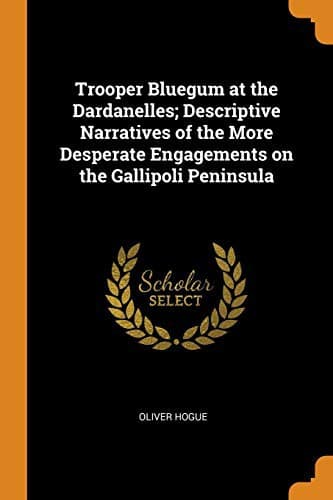
Trooper Bluegum at the Dardanelles: Descriptive Narratives of the More Desperate Engagements on the Gallipoli PeninsulaHogue, Oliver
History
Trooper Bluegum at the Dardanelles: Descriptive Narratives of the More Desperate Engagements on the Gallipoli Peninsula
Hogue, Oliver
World War, 1914-1918 -- Campaigns -- Turkey -- Gallipoli Peninsula; World War, 1914-1918 -- Personal narratives, Australian
Can you wonder that the Light Horse wanted to get a move on and make a
start for the front? Can you wonder that when we heard of the terrible
list of casualties which were the price of victory, and when we saw
our men coming back, many of them old friends, with their battle-scars
upon them, we fretted and fumed impatiently? We had a church parade,
and the chaplain, Captain Keith Miller, preached from the text, "Let us
run with patience the race that is set before us," and it only made us
angry. There was only one text that appealed to us, and that was "How
long, O Lord, how long?"
We could stand it no longer. Our boys needed reinforcements, and that
was all we cared about. They must have reinforcements. It would be
some days before men could arrive from England and France. Sir Ian
Hamilton wanted men to push home the attack and ensure the victory. We
knew that no cavalry could go for a couple of weeks, and our fellows
were just "spoiling for a fight." They were sick and tired of the
endless waiting, with wild rumours of moving every second day. Men from
all the troops and squadrons went to their officers and volunteered
to go as infantry, if only they could go at once. B Squadron, 6th
Regiment, volunteered _en masse_.
Colonel Ryrie, accurately gauging the temper of the men, summoned the
regimental commanders, Lieutenant-Colonel Cox, Lieutenant-Colonel
Harris and Lieutenant-Colonel Arnott. What happened at this little
Council of War we don't know. But we guess. Word was sent on to the
general that the whole brigade would leave for the front within an
hour, on foot if necessary.
A similar offer had just been made by the 1st Light Horse Brigade
(Colonel Chauvel) and the 1st Brigade of New Zealand Mounted Rifles.
What it cost these gallant horsemen to volunteer and leave their horses
behind only horsemen can guess. Colonel Ryrie's brigade was said to
be the best-horsed brigade in Egypt. Scores of men had brought their
own horses. After eight months of soldiering we were deeply attached to
our chargers. Fighting on foot was not our forte. We were far more at
home in the saddle. But Colonel Ryrie expressed the dominant thought of
the men when he said: "My brigade are mostly bushmen, and they never
expected to go gravel-crushing, but if necessary the whole brigade will
start to-morrow on foot, even if we have to tramp the whole way from
Constantinople to Berlin."
There was cheering all along the line when the news filtered through.
Men who had of late been swearing at the heat and dust and the flies
and the desert suddenly became jovial again. At dinner they passed the
joke along, sang songs, and cheered everybody, from Kitchener to Andy
Fisher, and the brigadier down to the cooks and the trumpeters.
So we are off at last, after weary months of waiting--on foot.
Blistered heels and trenches ahead; but it's better than sticking here
in the desert doing nothing.
CHAPTER VII
AT THE DARDANELLES
Public-domain text, read in full here on John Shaqi.
Reviews
Reviews
No reviews yet
Be the first to share your thoughts on this work.
Join the Discussion
Join the discussion
Sign in to leave a comment or review.
Sign InorCreate an account