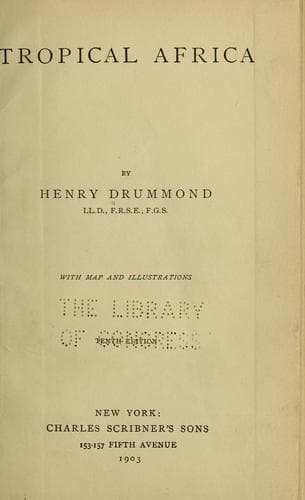
Africa, Central -- Description and travel; Africa, East -- Description and travel; Natural history -- Africa; Slave trade
The native tracks which I have just described are the same in
character all over Africa. They are veritable footpaths, never over
a foot in breadth, beaten as hard as adamant, and rutted beneath the
level of the forest bed by centuries of native traffic. As a rule
these footpaths are marvellously direct. Like the roads of the old
Romans, they run straight on through everything, ridge and mountain
and valley, never shying at obstacles, nor anywhere turning aside to
breathe. Yet within this general straightforwardness there is a
singular eccentricity and indirectness in detail. Although the
African footpath is on the whole a bee-line, no fifty yards of it are
ever straight. And the reason is not far to seek. If a stone is
encountered no native will ever think of removing it. Why should he?
It is easier to walk round it. The next man who comes that way will
do the same. He knows that a hundred men are following him; he looks
at the stone; a moment, and it might be unearthed and tossed aside,
but no; he also holds on his way. It is not that he resents the
trouble, it is the idea that is wanting. It would no more occur to
him that that stone was a displaceable object, and that for the
general weal he might displace it, than that its feldspar was of the
orthoclase variety. Generations and generations of men have passed
that stone, and it still waits for a man with an altruistic idea.
But it would be a very stony country indeed--and Africa is far from
stony--that would wholly account for the aggravating obliqueness and
indecision of the African footpath. Probably each four miles, on an
average path, is spun out by an infinite series of minor sinuosities,
to five or six. Now these deflections are not meaningless. Each has
some history--a history dating back, perhaps, a thousand years, but
to which all clue has centuries ago been lost. The leading cause,
probably, is fallen trees. When a tree falls across a path no man
ever removes it. As in the case of the stone, the native goes round
it. It is too green to burn in his hut; before it is dry, and the
white ants have eaten it, the new detour has become part and parcel
of the path. The smaller irregularities, on the other hand,
represent the trees and stumps of the primeval forest where the track
was made at first. But whatever the cause, it is certain that for
persistent straightforwardness in the general, and utter vacillation
and irresolution in the particular, the African roads are unique in
engineering.
Public-domain text, read in full here on John Shaqi.
Reviews
Reviews
No reviews yet
Be the first to share your thoughts on this work.
Join the Discussion
Join the discussion
Sign in to leave a comment or review.
Sign InorCreate an account