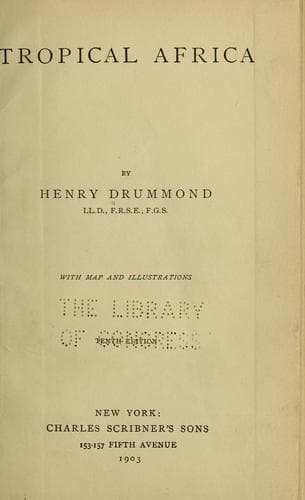
Africa, Central -- Description and travel; Africa, East -- Description and travel; Natural history -- Africa; Slave trade
The material excavated from these underground galleries and from the
succession of domed chambers--used as nurseries or granaries--to
which they lead, has to be thrown out upon the surface. And it is
from these materials that the huge ant-hills are reared, which form
so distinctive a feature of the African landscape. These heaps and
mounds are so conspicuous that they may be seen for miles, and so
numerous are they and so useful as cover to the sportsman, that
without them in certain districts hunting would be impossible. The
first things, indeed, to strike the traveller in entering the
interior are the mounds of the white ant, now dotting the plain in
groups like a small cemetery, now rising into mounds, singly or in
clusters, each thirty or forty feet in diameter and ten or fifteen in
height; or, again, standing out against the sky like obelisks, their
bare sides carved and fluted into all sorts of fantastic shapes. In
India these ant-heaps seldom attain a height of more than a couple of
feet, but in Central Africa they form veritable hills, and contain
many tons of earth. The brick houses of the Scotch mission-station
on Lake Nyassa have all been built out of a single ants' nest, and
the quarry from which the material has been derived forms a pit
beside the settlement some dozen feet in depth. A supply of bricks,
as large again, could probably still be taken from this convenient
depôt; and the missionaries on Lake Tanganyika and onwards to
Victoria Nyanza have been similarly indebted to the labors of the
termites. In South Africa the Zulus and Kaffirs pave all their huts
with white-ant earth; and during the Boer war our troops in
Praetoria, by scooping out the interior from the smaller
beehive-shaped ant-heaps, and covering the top with clay, constantly
used them as ovens. These ant-heaps may be said to abound over the
whole interior of Africa, and there are several distinct species.
The most peculiar as well as the most ornate, is a small variety from
one to two feet in height, which occurs in myriads along the shores
of Lake Tanganyika. It is built in symmetrical tiers, and resembles
a pile of small rounded hats, one above another, the rims depending
like eaves, and sheltering the body of the hill from rain. To
estimate the amount of earth per acre raised from the water-line of
the subsoil by white ants would not in some districts be an
impossible task; and it would be found, probably, that the quantity
at least equalled that manipulated annually in temperate regions by
the earthworm.
Public-domain text, read in full here on John Shaqi.
Reviews
Reviews
No reviews yet
Be the first to share your thoughts on this work.
Elsewhere in the archive
Join the Discussion
Join the discussion
Sign in to leave a comment or review.
Sign InorCreate an account