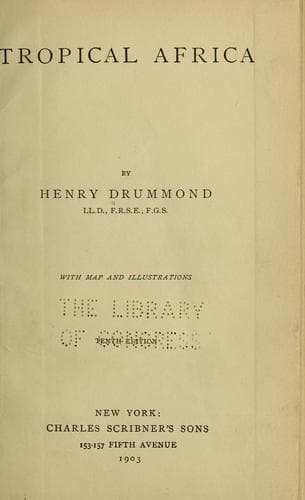
Africa, Central -- Description and travel; Africa, East -- Description and travel; Natural history -- Africa; Slave trade
These mounds, however, are more than mere waste-heaps. Like the
corresponding region underground, they are built into a meshwork of
tunnels, galleries, and chambers, where the social interests of the
community are attended to. The most spacious of these chambers,
usually far underground, is very properly allocated to the head of
the society, the queen. The queen-termite is a very rare insect, and
as there are seldom more than one, or at most two, to a colony, and
as the royal apartments are hidden far in the earth, few persons have
ever seen a queen, and indeed most, if they did happen to come across
it, from its very singular appearance, would refuse to believe that
it had any connection with white ants. It possesses, indeed, the
true termite head, but there the resemblance to the other members of
the family stops, for the size of the head bears about the same
proportion to the rest of the body as does the tuft on his Glengarry
bonnet to a six-foot Highlander. The phenomenal corpulence of the
royal body in the case of the queen-termite is possibly due in part
to want of exercise, for once seated upon her throne she never stirs
to the end of her days. She lies there, a large, loathsome,
cylindrical package, two or three inches long, in shape like a
sausage, and as white as a bolster. Her one duty in life is to lay
eggs, and it must be confessed she discharges her function with
complete success, for in a single day her progeny often amounts to
many thousands, and for months this enormous fecundity never
slackens. The body increases slowly in size, and through the
transparent skin the long folded ovary may be seen, with the eggs,
impelled by a peristaltic motion, passing onward for delivery to the
workers who are waiting to carry them to the nurseries where they are
hatched. Assiduous attention, meantime, is paid to the queen by
other workers, who feed her diligently, with much self-denial
stuffing her with morsel after morsel from their own jaws. A guard
of honor in the shape of a few of the larger soldier-ants is also in
attendance as a last and almost unnecessary precaution. In addition,
finally, to the soldiers, workers, and queen, the royal chamber has
also one other inmate--the king. He is a very ordinary-looking
insect, about the same size as the soldiers, but the arrangement of
the parts of the head and body is widely different, and like the
queen he is furnished with eyes.
Public-domain text, read in full here on John Shaqi.
Reviews
Reviews
No reviews yet
Be the first to share your thoughts on this work.
Elsewhere in the archive
Join the Discussion
Join the discussion
Sign in to leave a comment or review.
Sign InorCreate an account