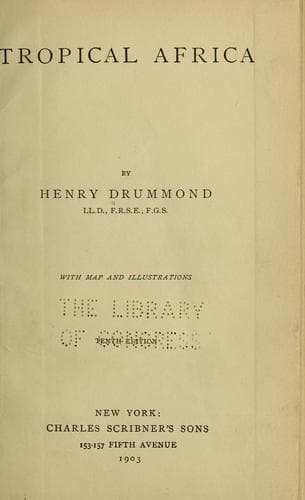
Africa, Central -- Description and travel; Africa, East -- Description and travel; Natural history -- Africa; Slave trade
Let me now attempt to show the way in which the work of the termites
bears upon the natural agriculture and geology of the tropics.
Looking at the question from the large point of view, the general
fact to be noted is, that the soil of the tropics is in a state of
perpetual motion. Instead of an upper crust, moistened to a paste by
the autumn rains, and then baked hard as adamant in the sun; and an
under soil hermetically sealed from the air and light, and
inaccessible to all the natural manures derived from the
decomposition of organic matters--these two layers being eternally
fixed in their relations to one another--we have a slow and continued
transference of the layers always taking place. Not only to cover
their depredations, but to dispose of the earth excavated from the
underground galleries, the termites are constantly transporting the
deeper and exhausted soils to the surface. Thus there is, so to
speak, a constant circulation of earth in the tropics, a ploughing
and harrowing, not furrow by furrow and clod by clod, but pellet by
pellet and grain by grain.
Some idea of the extent to which the underlying earth of the tropical
forests is thus brought to the surface will have been gathered from
the facts already described; but no one who has not seen it with his
own eyes can appreciate the gigantic magnitude of the process.
Occasionally one sees a whole trunk or branch, and sometimes almost
an entire tree, so swathed in red mud that the bark is almost
completely concealed, the tree looking as if it had been taken out
bodily and dipped in some crystallizing solution. It is not only one
tree here and there that exhibits the work of the white ant, but in
many places the whole forest is so colored with dull red tunnels and
patches as to give a distinct tone to the landscape--an effect which,
at a little distance, reminds one of the _abend-roth_ in a pine
forest among the Alps. Some regions are naturally more favorable
than others to the operations of the termites; and to those who have
only seen them at work in India or in the lower districts of Africa
this statement may seem an exaggeration. But on one range of
forest-clad hills on the great plateau between Lake Nyassa and
Tanganyika I have walked for miles through trees, every one of which,
without exception, was ramified, more or less, with tunnels. The
elevation of this locality was about 5000 feet above the sea and the
distance from the equator some 9°; but nowhere else have I seen a
spot where the termites were so completely masters of the situation
as here. If it is the case that in these, the most elevated regions
of Central Africa, the termite colonies attain their maximum
development, the fact is of much interest in connection with the
geological and agricultural function which they seem to serve; for it
is here precisely, before the rivers have gathered volume, that
alluvium is most wanting; it is here that the tiny headwaters of
Public-domain text, read in full here on John Shaqi.
Reviews
Reviews
No reviews yet
Be the first to share your thoughts on this work.
Elsewhere in the archive
Join the Discussion
Join the discussion
Sign in to leave a comment or review.
Sign InorCreate an account