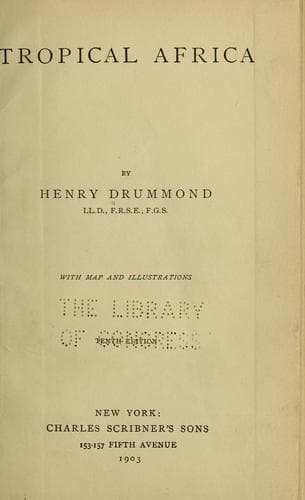
Africa, Central -- Description and travel; Africa, East -- Description and travel; Natural history -- Africa; Slave trade
these same rivers collect the earth for subsequent distribution over
the distant plains and coasts; and though the white ant may itself
have no power, in the first instance, of creating soil, as a denuding
and transporting agent, its ministry can scarcely be exaggerated. If
this is its function in the economy of nature, it is certainly clear
that the insect to which this task is assigned is planted where, of
all places, it can most effectively fulfil the end.
The direct relation of the termites' work to denudation will still
further appear if we try to imagine the effect upon the accumulations
of earth pellets and grains of an ordinary rainy season. For two or
three months in the tropics, though intermittently, the rains lash
the forests and soils with a fury such as we, fortunately, have
little idea of. And though the earthworks, and especially the larger
ant-hills, have marvellous resisting properties, they are not
invulnerable, and must ultimately succumb to denuding agents. The
tunnels, being only required for a temporary purpose, are made
substantial enough only to last the occasion. And in spite of the
natural glue which cements the pellets of earth together, the
structure, as a whole, after a little exposure, becomes extremely
friable, and crumbles to pieces at a touch. When the earth-tubes
crumble into dust in the summer season the debris is scattered over
the country by the wind, and this way tends to increase and refresh
the soil. During the rains, again, it is washed into the rivulets
and borne away to fertilize with new alluvium the distant valleys, or
carried downward to the ocean, where, along the coast line, it "sows
the dust of continents to be." Herodotus, with equal poetic and
scientific truth, describes Egypt as "the gift of the Nile."
Possibly had he lived to-day he might have carried his vision farther
back still, and referred some of it to the labors of the humble
termites in the forest slopes about Victoria Nyanza.
VII.
MIMICRY.
THE WAYS OF AFRICAN INSECTS.
Mimicry is imposture in nature. Carlyle in his blackest visions of
"shams and humbugs" among human kind never saw anything so finished
in hypocrisy as the naturalist now finds in every tropical forest.
There are to be seen creatures, not singly, but in tens of thousands,
whose very appearance, down to the minutest spot and wrinkle, is an
affront to truth, whose every attitude is a pose for a purpose, and
whose whole life is a sustained lie. Before these masterpieces of
deception the most ingenious of human impositions are vulgar and
transparent. Fraud is not only the great rule of life in a tropical
forest, but the one condition of it.
Public-domain text, read in full here on John Shaqi.
Reviews
Reviews
No reviews yet
Be the first to share your thoughts on this work.
Elsewhere in the archive
Join the Discussion
Join the discussion
Sign in to leave a comment or review.
Sign InorCreate an account