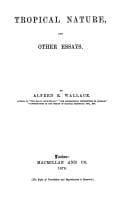
Tropical nature, and other essaysWallace, Alfred Russel
History
Tropical nature, and other essays
Wallace, Alfred Russel
Ecology -- Tropics; Natural history -- Tropics; Tropics
thousands of obscure species of insects which, if they were all
collected, would not improbably bring down the average of colour
to much about the same level as that of temperate zones.
But it is when we come to the vegetable world that the greatest
misconception on this subject prevails. In abundance and variety
of floral colour the tropics are almost universally believed to
be pre-eminent, not only absolutely, but relatively to the whole
mass of vegetation and the total number of species. Twelve years of
observation among the vegetation of the eastern and western tropics
has, however, convinced me that this notion is entirely erroneous,
and that, in proportion to the whole number of species of plants,
those having gaily-coloured flowers are actually more abundant in
the temperate zones than between the tropics. This will be found to
be not so extravagant an assertion as it may at first appear, if we
consider how many of the choicest adornments of our greenhouses and
flower-shows are really temperate as opposed to tropical plants.
The masses of colour produced by our Rhododendrons, Azaleas, and
Camellias, our Pelargoniums, Calceolarias, and Cinerarias,--all
strictly temperate plants--can certainly not be surpassed, if they
can be equalled, by any productions of the tropics.
It may be objected that most of the plants named are choice
cultivated _varieties_, far surpassing in colour the original stock,
while the tropical plants are mostly unvaried wild _species_.
But this does not really much affect the question at issue. For
our florists’ gorgeous varieties have all been produced under
the influence of our cloudy skies, and with even a still further
deficiency of light, owing to the necessity of protecting them
under glass from our sudden changes of temperature; so that
they are themselves an additional proof that tropical light and
heat are not needed for the production of intense and varied
colour. Another important consideration is, that these cultivated
_varieties_ in many cases displace a number of wild _species_
which are hardly, if at all, cultivated. Thus there are scores of
_species_ of wild hollyhocks varying in colour almost as much as the
cultivated varieties, and the same may be said of the pentstemons,
rhododendrons, and many other flowers; and if these were all brought
together in well-grown specimens, they would produce a grand effect.
But it is far easier, and more profitable for our nurserymen to
grow _varieties_ of one or two species, which all require a similar
culture, rather than fifty distinct _species_, most of which would
require special treatment; the result being that the varied beauty
of the temperate flora is even now hardly known, except to botanists
and to a few amateurs.
Public-domain text, read in full here on John Shaqi.
Reviews
Reviews
No reviews yet
Be the first to share your thoughts on this work.
Elsewhere in the archive
Join the Discussion
Join the discussion
Sign in to leave a comment or review.
Sign InorCreate an account