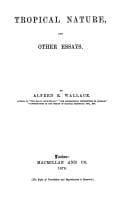
Tropical nature, and other essaysWallace, Alfred Russel
History
Tropical nature, and other essays
Wallace, Alfred Russel
Ecology -- Tropics; Natural history -- Tropics; Tropics
But we may go further, and say that the hardy plants of our cold
temperate zone equal, if they do not surpass, the productions of
the tropics. Let us only remember such gorgeous tribes of flowers
as the Roses, Pæonies, Hollyhocks, and Antirrhinums; the Laburnum,
Wistaria, and Lilac; the Lilies, Irises, and Tulips; the Hyacinths,
Anemones, Gentians, and Poppies; and even our humble Gorse, Broom,
and Heather; and we may defy any tropical country to produce masses
of floral colour in greater abundance and variety. It may be true
that individual tropical shrubs and flowers do surpass everything
in the rest of the world; but that is to be expected, because the
tropical zone comprises a much greater land area than the two
temperate zones, while, owing to its more favourable climate, it
produces a still larger proportion of species of plants, and a
greater number of peculiar natural orders.
Direct observation in tropical forests, plains, and mountains,
fully supports this view. Occasionally we are startled by some
gorgeous mass of colour, but as a rule we gaze upon an endless
expanse of green foliage, only here and there enlivened by not very
conspicuous flowers. Even the orchids, whose superb blossoms adorn
our stoves, form no exception to this rule. It is only in favoured
spots that we find them in abundance; the species with small and
inconspicuous flowers greatly preponderate; and the flowering
season of each kind being of short duration, they rarely produce
any marked effect of colour amid the vast masses of foliage which
surround them. An experienced collector in the Eastern tropics once
told me, that although a single mountain in Java had produced three
hundred species of Orchideæ, only about two per cent. of the whole
were sufficiently ornamental or showy to be worth sending home
as a commercial speculation. The Alpine meadows and rock-slopes,
the open plains of the Cape of Good Hope or of Australia, and the
flower-prairies of North America, offer an amount and variety of
floral colour which can certainly not be surpassed, even if it can
be equalled, between the tropics.
It appears, therefore, that we may dismiss the theory that the
development of colour in nature is directly dependent on, and in any
way proportioned to the amount of solar heat and light, as entirely
unsupported by facts. Strange to say, however, there are some rare
and little-known phenomena which prove, that in exceptional cases,
light does directly affect the colours of natural objects; and
it will be as well to consider these before passing on to other
matters.
Public-domain text, read in full here on John Shaqi.
Reviews
Reviews
No reviews yet
Be the first to share your thoughts on this work.
Elsewhere in the archive
Join the Discussion
Join the discussion
Sign in to leave a comment or review.
Sign InorCreate an account