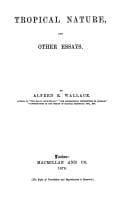
Tropical nature, and other essaysWallace, Alfred Russel
History
Tropical nature, and other essays
Wallace, Alfred Russel
Ecology -- Tropics; Natural history -- Tropics; Tropics
I have now concluded this sketch of the general phenomena of colour
in the organic world. I have shown reasons for believing that its
presence, in some of its infinitely-varied hues, is more probable
than its absence; and that variation of colour is an almost necessary
concomitant of variation of structure, of development, and of growth.
It has also been shown how colour has been appropriated and modified
both in the animal and vegetable worlds for the advantage of the
species in a great variety of ways, and that there is no need to
call in the aid of any other laws than those of organic development
and “natural selection” to explain its countless modifications.
From the point of view here taken it seems at once improbable and
unnecessary that the lower animals should have the same delicate
appreciation of the infinite variety and beauty--of the delicate
contrasts and subtle harmonies of colour, which are possessed by
the more intellectual races of mankind, since even the lower human
races do not possess it. All that seems required in the case of
animals, is a perception of _distinctness_ or _contrast_ of colours;
and the dislike of so many creatures to scarlet may perhaps be due
to the rarity of that colour in nature, and to the glaring contrast
it offers to the sober greens and browns which form the general
clothing of the earth’s surface, though it may also have a direct
irritating effect on the retina.
The general view of the subject now given must convince us that,
so far from colour being--as it has sometimes been thought to
be--unimportant, it is intimately connected with the very existence
of a large proportion of the species of the animal and vegetable
worlds. The gay colours of the butterfly and of the alpine flower
which it unconsciously fertilizes while seeking for its secreted
honey, are each beneficial to its possessor, and have been shown to
be dependent on the same class of general laws as those which have
determined the form, the structure, and the habits of every living
thing. The complex laws and unexpected relations which we have seen
to be involved in the production of the special colours of flower,
bird, and insect, must give them an additional interest for every
thoughtful mind; while the knowledge that, in all probability, each
style of coloration, and sometimes the smallest details, have a
meaning and a use, must add a new charm to the study of nature.
ON THE ORIGIN OF THE COLOUR-SENSE.
Throughout the preceding discussion we have accepted the subjective
phenomena of colour--that is, our perception of varied hues and
the mental emotions excited by them, as ultimate facts needing
no explanation. Yet they present certain features well worthy of
attention, a brief consideration of which will form a fitting sequel
to the present essay.
Public-domain text, read in full here on John Shaqi.
Reviews
Reviews
No reviews yet
Be the first to share your thoughts on this work.
Elsewhere in the archive
Join the Discussion
Join the discussion
Sign in to leave a comment or review.
Sign InorCreate an account