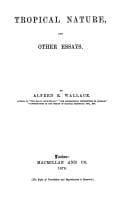
Tropical nature, and other essaysWallace, Alfred Russel
History
Tropical nature, and other essays
Wallace, Alfred Russel
Ecology -- Tropics; Natural history -- Tropics; Tropics
The perception of colour seems, to the present writer, the most
wonderful and the most mysterious of our sensations. Its extreme
diversities and exquisite beauties seem out of proportion to the
causes that are supposed to have produced them, or the physical
needs to which they minister. If we look at pure tints of red,
green, blue, and yellow, they appear so absolutely contrasted
and unlike each other, that it is almost impossible to believe
(what we nevertheless know to be the fact) that the rays of light
producing these very distinct sensations differ only in wave-length
and rate of vibration; and that there is from one to the other a
continuous series and gradation of such vibrating waves. The positive
diversity we see in them must then depend upon special adaptations
in ourselves; and the question arises--for what purpose have our
visual organs and mental perceptions become so highly specialised
in this respect?
When the sense of sight was first developed in the animal kingdom,
we can hardly doubt that what was perceived was light only, and its
more or less complete withdrawal. As the sense became perfected,
more delicate gradations of light and shade would be perceived;
and there seems no reason why a visual capacity might not have been
developed as perfect as our own, or even more so in respect of light
and shade, but entirely insensible to differences of colour except
in so far as these implied a difference in the quantity of light.
The world would in that case appear somewhat as we see it in good
stereoscopic photographs; and we all know how exquisitely beautiful
such pictures are, and how completely they give us all requisite
information as to form, surface-texture, solidity, and distance,
and even to some extent as to colour; for almost all colours are
distinguishable in a photograph by some differences of tint, and
it is quite conceivable that visual organs might exist which would
differentiate what we term colour by delicate gradations of some one
characteristic neutral tint. Now such a capacity of vision would
be simple as compared with that which we actually possess; which,
besides distinguishing infinite gradations of the _quantity_ of
light, distinguishes also, by a totally distinct set of sensations,
gradations of _quality_, as determined by differences of wave-lengths
or rate of vibration. At what grade in animal development this new
and more complex sense first began to appear we have no means of
determining. The fact that the higher vertebrates, and even some
insects, distinguish what are to us diversities of colour, by no
means proves that their _sensations_ of colour bear any resemblance
whatever to ours. An insect’s capacity to distinguish red from blue
or yellow may be (and probably is) due to perceptions of a totally
distinct nature, and quite unaccompanied by any of that sense of
enjoyment or even of radical distinctness which pure colours excite
in us. Mammalia and birds, whose structure and emotions are so
Public-domain text, read in full here on John Shaqi.
Reviews
Reviews
No reviews yet
Be the first to share your thoughts on this work.
Elsewhere in the archive
Join the Discussion
Join the discussion
Sign in to leave a comment or review.
Sign InorCreate an account