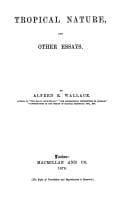
Tropical nature, and other essaysWallace, Alfred Russel
History
Tropical nature, and other essays
Wallace, Alfred Russel
Ecology -- Tropics; Natural history -- Tropics; Tropics
choicest productions of nature gratify the appetite and please the
eye. In the greatest heats of summer, coolness, shade, and moisture
are found in the green forest glades; and we can thus understand
how our visual apparatus has become especially adapted to receive
pleasurable and soothing sensations from this class of rays.
_Supposed increase of Colour-perception within the Historical
Period._--Some writers believe that our power of distinguishing
colours has increased even in historical times. The subject has
attracted the attention of German philologists, and I have been
furnished by a friend with some notes from a work of the late Lazarus
Geiger, entitled, _Zur Entwickelungsgeschichte der Menschheit_
(Stuttgart, 1871). According to this writer it appears that the
_colour_ of grass and foliage is never alluded to as a beauty in the
Vedas or the Zendavesta, though these productions are continually
extolled for other properties. Blue is described by terms denoting
sometimes green, sometimes black, showing that it was hardly
recognised as a distinct colour. The _colour_ of the sky is never
mentioned in the Bible, the Vedas, the Homeric poems, or even in
the Koran. The first distinct allusion to it known to Geiger is
in an Arabic work of the ninth century. “Hyacinthine locks” are
black locks, and Homer calls iron “violet-coloured.” Yellow was
often confounded with green; but, along with red, it was one of
the earliest colours to receive a distinct name. Aristotle names
three colours in the rainbow--red, yellow, and green. Two centuries
earlier Xenophanes had described the rainbow as purple, reddish,
and yellow. The Pythagoreans admitted four primary colours--white,
black, red, and yellow; the Chinese the same, with the addition of
green.
Public-domain text, read in full here on John Shaqi.
Reviews
Reviews
No reviews yet
Be the first to share your thoughts on this work.
Elsewhere in the archive
Join the Discussion
Join the discussion
Sign in to leave a comment or review.
Sign InorCreate an account