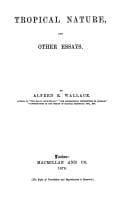
Tropical nature, and other essaysWallace, Alfred Russel
History
Tropical nature, and other essays
Wallace, Alfred Russel
Ecology -- Tropics; Natural history -- Tropics; Tropics
Simultaneously with the first publication of this essay in
_Macmillan’s Magazine_, there appeared in the _Nineteenth Century_ an
article by Mr. Gladstone on the Colour-sense, chiefly as exhibited
in the poems of Homer. He shows that the few colour-terms used by
Homer are applied to such different objects that they cannot denote
colours only, as we perceive and differentiate them; but seem more
applicable to different intensities of light and shade. Thus, to
give one example, the word _porphureos_ is applied to clothing, to
the rainbow, to blood, to a cloud, to the sea, and to death; and
no one meaning will suit all these applications except comparative
darkness. In other cases the same thing has many different epithets
applied to it according to its different aspects or conditions; and
as the colours of objects are generally indicated in ancient writings
by comparative rather than by abstract terms,--as wine-colour,
fire-colour, bronze-colour, &c.--it becomes still more difficult
to determine in any particular case what colour was really meant.
Mr. Gladstone’s general conclusion is, that the archaic man had a
positive perception only of degrees of light and darkness, and that
in Homer’s time he had advanced to the imperfect discrimination of
red and yellow, but no further; the green of grass and foliage or
the blue of the sky being never once referred to.
These curious facts cannot, however, be held to prove so recent an
origin for colour-sensations as they would at first sight appear to
do, because we have seen that both flowers and fruits have become
diversely coloured in adaptation to the visual powers of insects,
birds, and mammals. Red, being a very common colour of ripe fruits
which attract birds to devour them and thus distribute their seeds,
we may be sure that the contrast of red and green is to them very
well marked. It is indeed just possible that birds may have a more
advanced development of the colour-sense than mammals, because the
teeth of the latter commonly grind up and destroy the seeds of the
larger fruits and nuts which they devour, and which are not usually
coloured; but the irritating effect of bright colours on some of
them does not support this view. It seems most probable therefore
that man’s _perception_ of colour in the time of Homer was little
if any inferior to what it is now, but that, owing to a variety of
causes, no precise _nomenclature_ of colours had become established.
One of these causes probably was, that the colours of the objects
of most importance, and those which were most frequently referred
to in songs and poems, were uncertain and subject to variation.
Blood was light or dark red, or when dry, blackish; iron was grey
or dark or rusty; bronze was shining or dull; foliage was of all
shades of yellow, green, or brown; and horses or cattle had no one
distinctive colour. Other objects, as the sea, the sky, and wine,
changed in tint according to the light, the time of day, and the mode
Public-domain text, read in full here on John Shaqi.
Reviews
Reviews
No reviews yet
Be the first to share your thoughts on this work.
Elsewhere in the archive
Join the Discussion
Join the discussion
Sign in to leave a comment or review.
Sign InorCreate an account