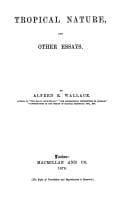
Tropical nature, and other essaysWallace, Alfred Russel
History
Tropical nature, and other essays
Wallace, Alfred Russel
Ecology -- Tropics; Natural history -- Tropics; Tropics
Another question which here comes before us, is the origin and
meaning of the odoriferous glands of leaves. Sir Joseph Hooker
informed me that not only are New-Zealand plants deficient in
bright-coloured and sweet-smelling flowers, but equally so in scented
leaves. This led me to think that perhaps such leaves were in some
way an additional attraction to insects--though it is not easy to
understand how this could be, except by adding a general attraction
to the special attraction of the flowers, or by supporting the
larvæ which, as perfect insects, aid in fertilization. Mr. Darwin,
however, informs me that he considers that leaf-glands bearing
essential oils are a protection against the attacks of insects
where these abound, and would thus not be required in countries
where insects were very scarce. But it seems opposed to this view
that highly aromatic plants are characteristic of deserts all
over the world, and in such places insects are not abundant. Mr.
Stainton informs me that the aromatic Labiatæ enjoy no immunity
from insect attacks. The bitter leaves of the cherry-laurel are
often eaten by the larvæ of moths that abound on our fruit-trees;
while in the Tropics the leaves of the orange tribe are favourites
with a large number of lepidopterous larvæ; and our northern firs
and pines, although abounding in a highly aromatic resin, are very
subject to the attacks of beetles. My friend Dr. Richard Spruce--who
while travelling in South America allowed nothing connected with
plant-life to escape his observation--informs me that trees whose
leaves have aromatic and often resinous secretions in immersed
glands abound in the plains of tropical America, and that such are
in great part, if not wholly, free from the attacks of leaf-eating
ants, except where the secretion is only slightly bitter, as in
the orange tribe, orange-trees being sometimes entirely denuded
of their leaves in a single night. Aromatic plants abound in the
Andes up to about 13,000 feet, as well as in the plains, but hardly
more so than in Central and Southern Europe. They are perhaps more
plentiful in the dry mountainous parts of Southern Europe; and
as neither here nor in the Andes do leaf-eating ants exist, Dr.
Spruce infers that, although in the hot American forests where such
ants swarm the oil-bearing glands serve as a protection, yet they
were not originally acquired for that purpose. Near the limits of
perpetual snow on the Andes such plants as occur are not, so far as
Dr. Spruce has observed, aromatic; and as plants in such situations
can hardly depend on insect visits for their fertilization, the
fact is comparable with that of the flora of New Zealand, and would
seem to imply some relation between the two phenomena, though what
it exactly is cannot yet be determined.
Public-domain text, read in full here on John Shaqi.
Reviews
Reviews
No reviews yet
Be the first to share your thoughts on this work.
Elsewhere in the archive
Join the Discussion
Join the discussion
Sign in to leave a comment or review.
Sign InorCreate an account