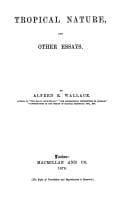
Tropical nature, and other essaysWallace, Alfred Russel
History
Tropical nature, and other essays
Wallace, Alfred Russel
Ecology -- Tropics; Natural history -- Tropics; Tropics
If we compare the productions of different islands, we meet with
peculiarities which throw much light on the subject of distribution.
In the Galapagos islands, between 500 and 600 miles from the west
coast of South America, there are thirty-two species of land-birds,
all but two or three being peculiar to the group. In Madeira,
about 400 miles from the coast of Morocco, there are nearly twice
as many land-birds as in the Galapagos, but only two of these are
peculiar to the island, the rest being South European or N. African
species. The Azores are 1,000 miles west of Portugal, and they
contain twenty-two species of land-birds, every one of which is
European except one bullfinch which is slightly different and forms
a peculiar species. This remarkable difference in the proportion of
peculiar species between the Galapagos and the Atlantic islands, is
well explained by the theory that land-birds rarely fly directly
out to sea, except when carried against their will by storms and
gales of wind. Now the Azores are situated in an especially stormy
zone, and it is an observed fact that after every severe gale of
wind some new bird or insect is seen on the islands. The Galapagos,
on the contrary, are in a very calm sea where violent storms are
almost unknown, and thus new birds from the mainland very rarely
visit these islands. Madeira is less stormy than the Azores, but
its comparative nearness makes up for this difference in the case
of birds. In insects, however, the species of Madeira are much
more peculiar (and more numerous) than those of the more distant
Azores; while those of the Galapagos are few, but all peculiar,
and belonging to groups many of which are widely spread over the
globe. All these facts are entirely in accordance with the view
that oceanic islands have been peopled from the nearest continents
by various accidental causes; while they are entirely opposed to
the theory that such islands are remnants of old continents and
have preserved some portion of their inhabitants.
Public-domain text, read in full here on John Shaqi.
Reviews
Reviews
No reviews yet
Be the first to share your thoughts on this work.
Elsewhere in the archive
Join the Discussion
Join the discussion
Sign in to leave a comment or review.
Sign InorCreate an account