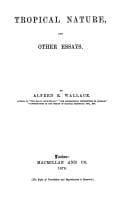
Tropical nature, and other essaysWallace, Alfred Russel
History
Tropical nature, and other essays
Wallace, Alfred Russel
Ecology -- Tropics; Natural history -- Tropics; Tropics
It is a curious fact, that land reptiles, such as snakes and
lizards, are found in many islands where there are no mammalia or
frogs; and we therefore conclude that there must be some means by
which their ova can be safely carried across great widths of sea.
A single peculiar frog inhabits New Zealand, and some species are
found in the Pacific islands as far eastward as the Fijis, but they
are absent from all other oceanic islands. Snakes also extend to
the Fijis, and there are two species in the Galapagos, but none in
the other oceanic islands. Lizards, however, are found in Mauritius
and Bourbon; in New Zealand; in all the Pacific islands, and in
the Galapagos. It is clear then that next to Mammals, frogs and
toads are most completely shut out by an ocean barrier; then follow
snakes, but as these are only found in the Galapagos and are very
like South American species, they may possibly have been conveyed
in boats or by floating trees. Lizards, however, are so wide-spread
over almost all the warmer islands of the great oceans, that they
must have some natural way of passing over, but the exact mode in
which this is effected has not yet been discovered. Birds, as we
have seen, are liable to be carried by winds and storms over great
widths of sea, but this only applies to certain groups; and large
numbers which feed on the ground or which inhabit the depths of
the forests, are almost as strictly confined to their respective
countries by even a narrow arm of the sea as are the majority of
the mammalia.
This sketch of the mode in which the various kinds of islands
have been stocked with their animal inhabitants forms the best
introduction to the study of those changes in our continents which
have led to the existing distribution of animals. It demonstrates
the importance of the sea as a _barrier_ to the spread of all the
higher animals; and we are thus naturally led on to inquire, how
far and to what extent such barriers have in past time existed
between lands which are now united, and on the other hand what
existing oceanic barriers are of comparatively recent origin.
In pursuing this inquiry we shall have to take account of those
grand views of the course of nature associated with the names of
Lyell and Darwin--of the slow but never-ceasing changes in the
physical conditions, the outlines and the mutual relations of the
land-surfaces of the globe; and of the equally slow and equally
unceasing changes in the forms and structures of all organisms,
to a great extent correlated with, and perhaps dependent on, the
former set of changes. Combining these two great principles with
other ascertained causes of distribution, we shall be enabled to
deal adequately with the problem before us, and give a rational,
though often only an approximative and conjectural, solution of the
many strange anomalies we meet with in studying the distribution
of living things.
Public-domain text, read in full here on John Shaqi.
Reviews
Reviews
No reviews yet
Be the first to share your thoughts on this work.
Elsewhere in the archive
Join the Discussion
Join the discussion
Sign in to leave a comment or review.
Sign InorCreate an account