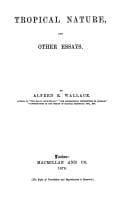
Tropical nature, and other essaysWallace, Alfred Russel
History
Tropical nature, and other essays
Wallace, Alfred Russel
Ecology -- Tropics; Natural history -- Tropics; Tropics
There remains to be considered the supposed indications of a very
ancient communication between Africa, Madagascar, Ceylon, Malaya,
and Celebes, furnished by the occurrence over this extensive area
of isolated forms of the Lemur tribe. The anomalous range of this
group of animals has been thought to require for its explanation
the existence of an ancient southern continent which has been
called Lemuria, but a consideration of all the facts does not seem
to warrant such a theory. Had such a continent ever existed we are
sure that it must have disappeared long before the Miocene period,
or it would assuredly have left more numerous and widespread
indications of the former connections of these distant lands than
actually exist. And when we go back to the Eocene period we are met
by the interesting discovery of an undoubtedly Lemurine animal in
France, and what are supposed to be allied forms in North America.
This proof of the great antiquity and wide range of lemurs is
quite in accordance with their low grade of development; while the
extreme isolation and specialization of many of the existing types
(of which the Aye-aye of Madagascar is a wonderful example), and
their scattered distribution over a wide tropical area, all suggest
the idea that these are but the remnants of a once extensive and
widely distributed group of animals, which, in competition with
higher forms, have preserved themselves either by their solitary
and nocturnal habits, or by restriction to ancient islands, like
Madagascar, where the struggle for existence has been less severe.
Lemuria, therefore, may be discarded as one of those temporary
hypotheses which are useful for drawing attention to a group of
anomalous facts, but which fuller knowledge shows to be unnecessary.
_Regions of the New World._--We will now pass across the Atlantic
to the Western Hemisphere, and consider first the Nearctic region,
or temperate North America, whose present and past zoological
relations with the rest of the world are of exceeding interest.
If we omit such animals as the musk-sheep (Ovibos), which is
purely Arctic, and the peccaries (Dicotyles), which are hardly
less distinctly tropical, the land-mammalia of North America
are not very numerous; and they can be for the most part divided
into two groups, the one allied to the Palæarctic, and the other
to the Neotropical fauna. The bears, the wolves, the cats, the
bison, sheep and antelope, the hares, the marmots, and the pikas,
resemble Palæarctic forms; while the racoons, skunks, opossum, and
vesper-mice are now more peculiarly Neotropical. There are also
many genera which are altogether peculiar and characteristic of the
region, as the prong-horn antelope (Antilocapra), the jumping-mouse
(Jaculus), five genera of pouched rats (Saccomyidæ), the prairie
dogs (Cynomys), the tree porcupines (Erethizon), and some others.
Public-domain text, read in full here on John Shaqi.
Reviews
Reviews
No reviews yet
Be the first to share your thoughts on this work.
Elsewhere in the archive
Join the Discussion
Join the discussion
Sign in to leave a comment or review.
Sign InorCreate an account