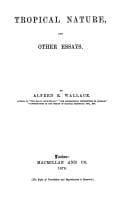
Tropical nature, and other essaysWallace, Alfred Russel
History
Tropical nature, and other essays
Wallace, Alfred Russel
Ecology -- Tropics; Natural history -- Tropics; Tropics
Birds present the same mixture of the two types; but the wild turkeys
(Meleagris), the passenger pigeon (Ectopistes), the crested quails
(Lophortyx, &c.), the ruffed grouse (Cupidonia), and some other
groups of less importance, are peculiar; while the family of the
wood warblers (Mniotiltidæ) is so largely developed that it may
claim to be more characteristic of North than of South America.
Reptiles and Amphibia present a number of peculiar types; while no
less than five peculiar families of fresh-water fishes would alone
serve to mark out this as distinct from every other part of the
world.
Considering the evident affinity between the Nearctic and Palæarctic
regions, there are here some curious deficiencies of groups which
are common and widely spread in the latter. Thus hedgehogs, wild
horses and asses, swine, true oxen, goats, dormice, and true mice are
absent; while sheep and antelopes are only represented by solitary
species in the Rocky Mountains. Among birds, too, we have such
striking deficiencies as the extensive families of flycatchers,
starlings, and pheasants.
Turning now to the Neotropical region, comprising all South America
and the tropical parts of the northern continent, we find that the
Old World types have still further diminished, while a number of new
and altogether peculiar forms have taken their place. Insectivora
have wholly disappeared with the exception of one anomalous form
in the greater Antilles; bears are represented by one Chilian
species; swine are replaced by peccaries; the great Bovine family
are entirely unknown; the camel tribe are confined to the Southern
Andes and the south-temperate plains; deer are not numerous; and
all the varied Ungulata of the Old World are represented only by
a few species of tapirs. These great gaps are, however, to some
extent filled up by a variety of interesting and peculiar types. Two
families of monkeys (Cebidæ and Hapalidæ) differ in many points of
structure from all the Quadrumana of the eastern hemisphere. There
is a peculiar family of bats--the vampyres; many peculiar weasels
and Procyonidæ; a host of peculiar rodents, comprising five distinct
families, among which are the largest living forms of the order; and
a great number of Edentata, comprising the families of the sloths,
armadillos, and ant-eaters; and lastly, a considerable number of
the marsupial family of opossums. As compared with the Old World,
we find here a great abundance and variety of the lower types, with
a corresponding scarcity of such higher forms as characterise the
tropics of Africa and Asia.
Public-domain text, read in full here on John Shaqi.
Reviews
Reviews
No reviews yet
Be the first to share your thoughts on this work.
Elsewhere in the archive
Join the Discussion
Join the discussion
Sign in to leave a comment or review.
Sign InorCreate an account