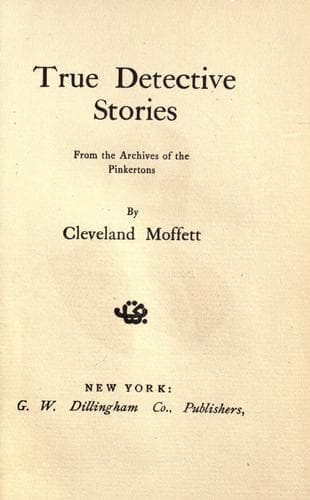
True Detective Stories from the Archives of the PinkertonsMoffett, Cleveland
History
True Detective Stories from the Archives of the Pinkertons
Moffett, Cleveland
Crime -- United States; Criminals -- United States; Detective and mystery stories, American
On the 29th of November Robert Pinkerton received word by telegraph
that Proctor had left Susquehanna suddenly in the night, telling the
agent of the express company that he would return the next day. This
looked very much as if Proctor had played him false, since it had been
expressly stipulated that he should not go away without Mr.
Pinkerton's permission. Days went by, and Proctor did not return. Then
word came from one of the Pinkerton men at Fort Erie that Proctor had
arrived at Donahue's hotel and had been joined there by Collins. This
was a serious setback for the detectives. Not only were the three
robbers safe from arrest where they were, but being fully aware of
the danger threatening them, and being men of shrewdness, it was fair
to presume that they would now move with great caution.
It soon became evident that Donahue and Collins were thoroughly
alarmed by the news Proctor had brought them; for they at once took
energetic steps to mislead any one who might be watching them. Having
retired as usual one night, they arose later, and drove in a wagon to
a station on the Grand Trunk Railroad, where they boarded a freight
train for Toronto. After a brief stay in that city they went on to
Montreal, where they tried hard to lose themselves, but were
unsuccessful, and returned to Fort Erie.
Meanwhile Mr. Pinkerton discovered that the story told him by Proctor
was entirely untrue. So far from having been an honest man before the
robbery, it came to light that he was already at that time a hardened
criminal, having committed burglaries both in the United States and
Canada, and having been sentenced, under another name, to a term in
the Massachusetts State prison. While in prison he had contrived to
make keys that would unlock his own cell and those of three other
prisoners, and the four had thus made their escape. One of them was
the notorious Charles Bullard, who was at that time serving a term of
twenty years for the robbery of the Boylston Bank of Boston. Proctor
had also offered the privilege of escape to Scott and Dunlap, the
Northampton Bank robbers, who were confined in the same prison, but
they had distrusted his plan, and refused to avail themselves of it.
Public-domain text, read in full here on John Shaqi.
Reviews
Reviews
No reviews yet
Be the first to share your thoughts on this work.
Join the Discussion
Join the discussion
Sign in to leave a comment or review.
Sign InorCreate an account