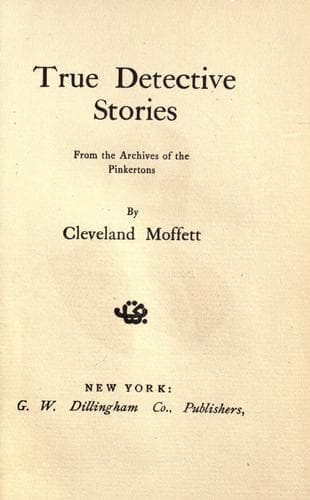
True Detective Stories from the Archives of the PinkertonsMoffett, Cleveland
History
True Detective Stories from the Archives of the Pinkertons
Moffett, Cleveland
Crime -- United States; Criminals -- United States; Detective and mystery stories, American
The United States Express Company had not relaxed its efforts against
his associates after Proctor's capture. Donahue and Collins returned
to Montreal, well satisfied with the work they had done, and thinking
themselves safe from pursuit. But President Platt instructed Robert
Pinkerton to take every measure possible against them, and it was
decided that as Donahue could not be reached and punished for the
robbery at Susquehanna, he should be made to suffer for the early
robbery at Quebec already referred to. Donahue's complicity in this
robbery was proved by the discovery of a part of the stolen goods in
his hotel at Fort Erie. Through the efforts of the express company and
the Pinkertons he was now arrested, and on trial was convicted and
sentenced to five years' imprisonment in the Kingston penitentiary.
After his conviction Donahue told the detectives that he was a fool to
have had anything to do with such a dangerous project as an express
robbery, but that the opportunity at Susquehanna was so tempting that
he could not resist it. After his arrest the express company attached
all of his property, and, although they did not succeed in getting a
judgment against him, they fought him in the courts until his wife,
acting for him, was obliged to mortgage all their possessions up to
the last dollar, so that they never derived any substantial benefit
from the stolen money.
As for Collins, he remained a fugitive from justice for some time
after the conviction of Proctor and Donahue. Several years later,
however, seeing himself constantly threatened by the express company
and the detectives, he decided to placate his enemies by stepping out
from the ranks of the law-breakers and trying to lead an honest life.
And he has succeeded, as the Pinkertons have reason to know; and his
case goes to prove what is borne out by wide experience, that even the
most desperate criminals are sometimes capable of genuine reform.
The Pollock Diamond Robbery
There were thirteen men in the smoker of a train on the Sioux City and
Pacific Railroad when it drew out of Omaha at six o'clock on Friday
evening, November 4, 1892, and started on its eastward run. Among
these thirteen, sitting about half-way down the aisle, enjoying a good
cigar, was Mr. W. G. Pollock of New York, a traveling salesman for W.
L. Pollock & Co., of the same city, dealers in diamonds. In the inside
pocket of his vest he carried fifteen thousand dollars' worth of uncut
diamonds, while a leather satchel on the seat beside him contained a
quantity of valuable stones in settings.
Public-domain text, read in full here on John Shaqi.
Reviews
Reviews
No reviews yet
Be the first to share your thoughts on this work.
Join the Discussion
Join the discussion
Sign in to leave a comment or review.
Sign InorCreate an account