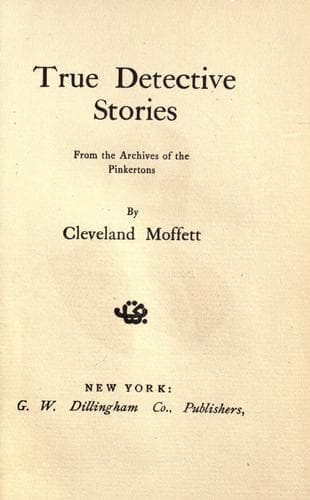
True Detective Stories from the Archives of the PinkertonsMoffett, Cleveland
History
True Detective Stories from the Archives of the Pinkertons
Moffett, Cleveland
Crime -- United States; Criminals -- United States; Detective and mystery stories, American
Sharing, apparently, in the general consternation and terror inspired
by the young fellow, the conductor, instead of holding the train to
pursue the thief, signaled the engineer to go ahead, and no effort was
made for a capture until the train reached California Junction,
several miles farther on. Meanwhile the panic-stricken passengers
recovered, at their leisure, their composure and their seats. Had but
one of his fellow-travelers gone to the assistance of Mr. Pollock, the
robber might easily have been overpowered. As it was, he all but
murdered his man, plundered him of his diamonds, and escaped without
the slightest interference. When his pistol was picked up, near the
spot where he left the train, it was found that in the struggle the
cylinder had caught, so that it would have been impossible to
discharge the two chambers remaining loaded. Thus eleven able-bodied
men were held in a state of abject terror by one slender lad, who at
the last was practically unarmed.
At California Junction the wounded diamond-merchant was carried from
the train, and that same night taken back to Omaha. Mr. Pollock, being
a member of the Jewelers' Protective Union, a rich and powerful
organization, established some years ago for the protection of jewelry
salesmen against thieves, was entitled to its aid.
When the detectives reached the scene of the robbery, the robber had
vanished as completely as if he had been whisked off to another
planet. To be sure, farmers in the neighborhood brought rumors of the
stealing of horses, of a strange man sleeping in the woods, and of a
desperate-looking character seen limping along the road. But all this
came to nothing, except to establish, what seemed probable, that the
diamond-thief had fled back to Omaha. A patient and exhaustive search
in Omaha resulted in nothing. The man was gone, and the diamonds were
gone; that was all anybody knew.
What made the case more difficult was the uncertainty as to the
robber's personal appearance; for some of the passengers testified to
one thing, and some to another. The black beard was a cause of
confusion; only one witness besides Mr. Pollock remembered that the
man wore such a beard. Mr. Pollock, however, was positive as to this
particular, and it seemed as if he ought to know. It was also
impossible to decide, from conflicting statements, whether the robber
had a mustache or not, and whether it was dark or light in color. The
fact is, the passengers had been so thoroughly frightened at the time
of the assault that the credibility of their testimony was much to be
questioned.
Public-domain text, read in full here on John Shaqi.
Reviews
Reviews
No reviews yet
Be the first to share your thoughts on this work.
Join the Discussion
Join the discussion
Sign in to leave a comment or review.
Sign InorCreate an account