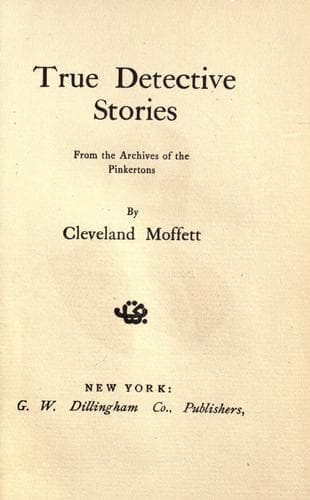
True Detective Stories from the Archives of the PinkertonsMoffett, Cleveland
History
True Detective Stories from the Archives of the Pinkertons
Moffett, Cleveland
Crime -- United States; Criminals -- United States; Detective and mystery stories, American
Although the messengers--Edward S. Crawford and old "Dominie"
Earle--were among the bank's most trusted employees, their honesty
being considered above suspicion, they were nevertheless followed at a
short distance by bank detective McDougal, an old-time police
detective, whose snow-white beard and ancient style of dress have long
made him a personage of note on Broadway. Detective McDougal followed
the messengers, not because he had any fear that they were planning a
robbery, but because it is an imperative rule of all great banking
institutions that the transfer of large sums of money, even for very
short distances, shall be watched over with the most scrupulous care.
Each messenger is supposed to act as a check on his fellow, while the
detective walking in the rear is a check on both. In such cases all
three men are armed, and would use their weapons without hesitation
should an attack be made upon them.
The messengers walked on through the hurrying crowd, keeping on the
east sidewalk as far as Wall Street, where they turned across, and
continued their way on the west sidewalk as far as the Adams Express
Company's building, which stands at No. 59 Broadway. Having seen them
safely inside the building, the detective turned back to the bank,
where his services were required in other matters.
Passing down the large room strewn with boxes and packages ready for
shipment, the two messengers turned to the right, and ascended the
winding stairs that in those days led to the money department, on the
second floor. No one paid much attention to them, as at this busy hour
bank messengers were arriving and departing every few minutes. Still,
some of the clerks remembered afterward, or thought they did, that
the old man, Earle, ascended the stairs more slowly than his more
active companion, who went ahead, carrying the valise alone. Both
messengers, however, were present at the receiving-window of the money
department when the package was taken from the valise and handed to
the clerk, who gave a receipt for it in the usual form: "Received from
the American Exchange Bank one package marked as containing forty-one
thousand dollars, for transfer to Washington"; or, at least, so far as
has ever been proved, both messengers were present when the package
was handed in.
Public-domain text, read in full here on John Shaqi.
Reviews
Reviews
No reviews yet
Be the first to share your thoughts on this work.
Elsewhere in the archive
Join the Discussion
Join the discussion
Sign in to leave a comment or review.
Sign InorCreate an account