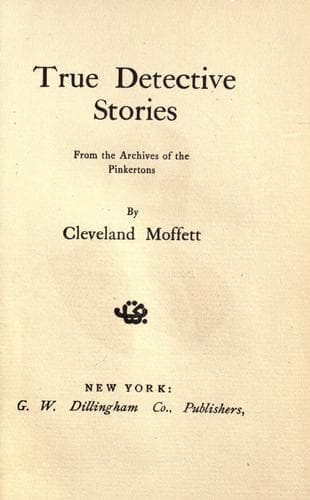
True Detective Stories from the Archives of the PinkertonsMoffett, Cleveland
History
True Detective Stories from the Archives of the Pinkertons
Moffett, Cleveland
Crime -- United States; Criminals -- United States; Detective and mystery stories, American
The two messengers, having performed their duty, went away, Earle
hurrying to the ferry to catch a train out into New Jersey, where he
lived, and Crawford returning to the bank with the empty valise. The
valuable package had meantime been ranged behind the heavily wired
grating along with dozens of others, some of them containing much
larger sums. The clerks in the money department of the Adams Express
Company become so accustomed to handling gold, silver, and bank-notes,
fortunes done up in bags, boxes, or bundles, that they think little
more of this precious merchandise than they might of so much coal or
bricks. A quick glance, a touch of the hand, satisfies them that the
seals, the wrappings, the labels, the general appearance, of the
packages are correct; and having entered them duly on the way-bills
and turned them over to the express messenger who is to forward them
to their destination, they think no more about them.
In this instance the forty-one-thousand-dollar package, after a brief
delay, was locked in one of the small portable safes, a score of which
are always lying about in readiness, and was lowered to the basement,
where it was loaded on one of the company's wagons. The wagon was then
driven to Jersey City, guarded by the messenger in charge, his
assistant, and the driver, all three men being armed, and was safely
placed aboard the night express for Washington. It is the company's
rule that the messenger who starts with a through safe travels with it
to its destination, though he has to make a journey of a thousand
miles. Sometimes the destination of money under transfer is so remote
that the service of several express companies is required; and in that
case the messenger of the Adams Company accompanies the money only to
the point where it is delivered to the messenger of the next company,
and so on.
The next morning, when the package from the American Exchange Bank was
delivered in Washington, the experienced Treasury clerk who received
it perceived at once, from the condition of the package, that
something was wrong. Employees of the Treasury Department seem to gain
a new sense, and to be able to distinguish bank-notes from ordinary
paper merely by the "feel," even when done up in bundles. Looking at
the label mark of forty-one thousand dollars, the clerk shook his
head, and called the United States Treasurer, James W. Hyatt, who also
saw something suspicious in the package. Mr. Blanchard, the Washington
agent of the Adams Express Company, was summoned, and in his presence
the package was opened. It was found to contain nothing more valuable
than slips of brown straw paper, the coarse variety used by butchers
in wrapping up meat, neatly cut to the size of bank-notes. The
forty-one thousand dollars were missing.
It was evident that at some point between the bank and the Treasury a
bogus package had been substituted for the genuine one. The question
was, Where and by whom had the substitution been made?
Public-domain text, read in full here on John Shaqi.
Reviews
Reviews
No reviews yet
Be the first to share your thoughts on this work.
Elsewhere in the archive
Join the Discussion
Join the discussion
Sign in to leave a comment or review.
Sign InorCreate an account