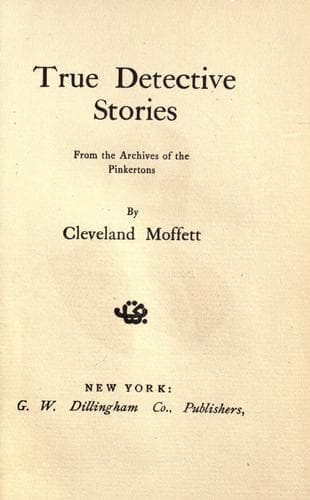
True Detective Stories from the Archives of the PinkertonsMoffett, Cleveland
History
True Detective Stories from the Archives of the Pinkertons
Moffett, Cleveland
Crime -- United States; Criminals -- United States; Detective and mystery stories, American
The robbery was discovered at the Treasury in Washington on Saturday
morning. The news was telegraphed to New York immediately, and on
Saturday afternoon anxious councils were held by the officials of the
American Exchange Bank and the Adams Express Company. Inspector Byrnes
was notified; the Pinkerton Agency was notified; and urgent despatches
were sent to Mr. John Hoey, president of the express company, and to
Robert Pinkerton, who were both out of town, that their presence was
required immediately in New York. Meanwhile every one who had had any
connection with the stolen package--the paying-teller of the bank,
other bank clerks, the messengers, detective McDougal, the
receiving-clerks of the Adams Express Company, and the express
messenger--was closely examined. Where and how the forty-one thousand
dollars had been stolen was important to learn not only in itself, but
also to fix responsibility for the sum lost as between the bank and
the express company.
Three theories were at once suggested: the bogus package might have
been substituted for the genuine one either at the bank, between the
bank and the express office, or between the express office and the
Treasury. The first assumption threw suspicion on some of the bank
employees, the second upon the two bank messengers, the third upon
some one in the service of the express company. Both the bank and the
express company stoutly maintained the integrity of its own employees.
An examination of the bogus package disclosed some points of
significance. Ordinarily, when bank-notes are done up for shipment by
an experienced clerk, the bills are pressed together as tightly as
possible in small bundles, which are secured with elastic bands, and
then wrapped snugly in strong paper, until the whole makes a package
almost as hard as a board. Around this package the clerk knots strong
twine, melts a drop of sealing-wax over each knot, and stamps it with
the bank's seal. The finished package thus presents a neat and trim
appearance. But in the present instance the package received at the
Treasury was loosely and slovenly wrapped, and the seals seemed to
have been put on either in great haste or by an inexperienced hand.
Moreover, the label must have been cut from the stolen package and
pasted on the other, for the brown paper of a previous wrapping showed
plainly in a margin running around the label. The address on the
package read:
"$41,000.
"United States Treasurer,
"Washington,
"D. C."
All this was printed, except the figures "41,000," even the
dollar-sign. The figures were in the writing of Mr. Watson, the
paying-teller of the bank, whose business it was to oversee the
sending of the money. His initials were also marked on the label, with
the date of the sending; so that on examining the label Mr. Watson
himself was positive that it was genuine.
Public-domain text, read in full here on John Shaqi.
Reviews
Reviews
No reviews yet
Be the first to share your thoughts on this work.
Elsewhere in the archive
Join the Discussion
Join the discussion
Sign in to leave a comment or review.
Sign InorCreate an account