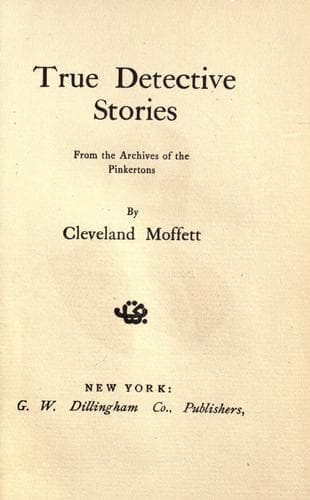
True Detective Stories from the Archives of the PinkertonsMoffett, Cleveland
History
True Detective Stories from the Archives of the Pinkertons
Moffett, Cleveland
Crime -- United States; Criminals -- United States; Detective and mystery stories, American
Finally came the theory that the money package had been stolen while
in the care of the express company. In considering this possibility it
became necessary to know exactly what had happened to the package from
the moment it was taken through the window of the money department up
to the time of its delivery at the Treasury. The package was first
receipted for by the head of the money department, Mr. J. C. Young.
Having handed the receipt to the bank messengers, he passed the
package to his assistant, Mr. Littlefield, who in turn passed it on to
another clerk, Mr. Moody, who way-billed it in due form for
Washington, and then placed it in the iron safe which was to carry it
on its journey. Two or three hours may have elapsed between the
receipt of the package and the shipment of the safe, but during this
time the package was constantly in view of five or six clerks in the
money department, and, unless they were all in collusion, it could
scarcely have been stolen by any one there. As for the express
messenger who accompanied the safe on the wagon to the train, and then
on the train to Washington, and then on another wagon to the Treasury
building, his innocence seemed clearly established, since the safe had
been locked and sealed, according to custom, before its delivery to
him, and showed no signs of having been tampered with when opened in
Washington the following morning by another representative of the
express company. The messenger who accompanies a through safe to its
destination, indeed, has small chance of getting inside, not only
because of the protecting seal, but also because he is never allowed
to have the key to the safe or to know its combination. Recently, as a
still further safeguard, the Adams Express Company has introduced into
its cars an equipment of large burglar-proof and fire-proof safes,
especially as a guard against train robbers, who found it
comparatively easy to break open the small safes once in use. In the
present instance, of course, there was no question of train robbers.
One important fact stood out plain and uncontrovertible: that a
responsible clerk in the money department of the Adams Express
Company had receipted for a package supposed to contain forty-one
thousand dollars intrusted to the company by the bank. This threw the
responsibility on the company, at least until it could be shown that
the package as delivered contained brown paper, and not bank-notes. In
accordance with their usual policy of promptness and liberality, the
Adams people paid over to the American Exchange Bank the sum of
forty-one thousand dollars, and said no more about it. But their
silence did not mean inactivity. Their instructions to their
detectives in this case, as in all similar cases, were to spare
neither time nor expense, but to continue the investigation until the
thieves had been detected and brought to punishment, or until the last
possibility of clearing up the mystery had certainly expired.
Public-domain text, read in full here on John Shaqi.
Reviews
Reviews
No reviews yet
Be the first to share your thoughts on this work.
Elsewhere in the archive
Join the Discussion
Join the discussion
Sign in to leave a comment or review.
Sign InorCreate an account