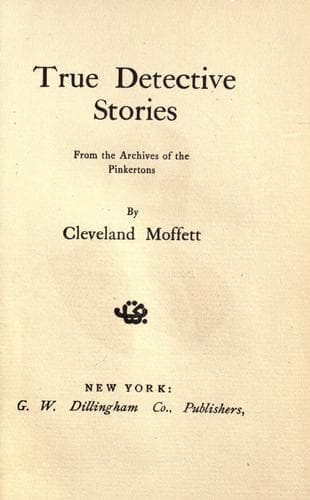
True Detective Stories from the Archives of the PinkertonsMoffett, Cleveland
History
True Detective Stories from the Archives of the Pinkertons
Moffett, Cleveland
Crime -- United States; Criminals -- United States; Detective and mystery stories, American
Hastening to New York in response to the telegram sent him, Robert
Pinkerton examined the evidence already collected by his
representative, and then himself questioned all persons in any way
concerned in the handling of the money. Mr. Pinkerton, after his
investigation, was not so sure as some persons were that the package
had been stolen by employees of the express company. He inclined
rather to the opinion that, in the rush of business in the express
office, the false package, badly made up though it was, might have
been passed by one of the clerks. This conclusion turned his
suspicions first toward the two bank messengers. Of these he was not
long in deciding Dominie Earle to be, in all probability, innocent.
While he had known of instances where old men, after years of
unimpeachable life, had suddenly turned to crime, he knew such cases
to be infrequent, and he decided that Earle's was not one of them. Of
the innocence of the other messenger, Crawford, he was not so sure. He
began a careful study of his record.
Edward Sturgis Crawford at this time was about twenty-seven years old,
a man of medium height, a decided blond, with large blue eyes, and of
a rather effeminate type. He went scrupulously dressed, had white
hands with carefully manicured nails, parted his hair in the middle,
and altogether was somewhat of a dandy. He had entered the bank on the
recommendation of a wealthy New-Yorker, a young man about town, who,
strange to say, had made Crawford's acquaintance, and indeed struck up
quite a friendship with him, while the latter was serving in the
humble capacity of conductor on a Broadway car. This was about a year
before the time of the robbery. Thus far Crawford had attended to his
work satisfactorily, doing nothing to arouse suspicion, unless it was
indulging a tendency to extravagance in dress. His salary was but
forty-two dollars a month, and yet he permitted himself such luxuries
as silk underclothes, fine patent-leather shoes, and other apparel to
correspond. Pushing back further into Crawford's record, Mr. Pinkerton
learned that he had grown up in the town of Hancock, New York, where
he had been accused of stealing sixty dollars from his employer and
afterward of perpetrating a fraud upon an insurance company. Putting
all these facts together, Mr. Pinkerton decided that, in spite of a
perfectly self-possessed manner and the good opinion of his employers,
Crawford would stand further watching. His general conduct subsequent
to the robbery was, however, such as to convince every one, except the
dogged detective, that he was innocent of this crime. In vain did
"shadows" follow him night and day, week after week; they discovered
nothing. He retained his place in the bank, doing the humble duties of
messenger with the same regularity as before, and living apparently in
perfect content with the small salary he was drawing. His expenses
were lightened, it is true, by an arrangement voluntarily offered by
Public-domain text, read in full here on John Shaqi.
Reviews
Reviews
No reviews yet
Be the first to share your thoughts on this work.
Elsewhere in the archive
Join the Discussion
Join the discussion
Sign in to leave a comment or review.
Sign InorCreate an account