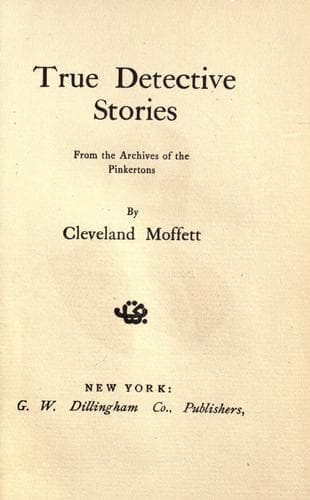
True Detective Stories from the Archives of the Pinkertons — John Shaqi
True Detective Stories from the Archives of the PinkertonsMoffett, Cleveland
History
True Detective Stories from the Archives of the Pinkertons
Moffett, Cleveland
Crime -- United States; Criminals -- United States; Detective and mystery stories, American
The story told by Evans is one of the most remarkable in the history
of crime. He admitted the correctness of Robert Pinkerton's inference
that the Northampton Bank had been robbed by Scott and Dunlap and
their associates, and in order to explain his own connection with this
formidable gang he went back to its organization in 1872. The leader
of the gang was James Dunlap, _alias_ James Barton, who, before he
became a bank robber, had been a brakeman on the Chicago, Alton and
St. Louis Railroad. His inborn criminal instincts led him to frequent
the resorts of thieves in Chicago, and thus he met "Johnny" Lamb and a
man named Perry, who took a liking to him and taught him all they knew
about breaking safes. Dunlap soon outstripped his masters, developing
a genius for robbery and for organization that speedily proved him the
most formidable of all the bank robbers then operating in the country,
not even excepting "Jimmy" Hope, the notorious Manhattan Bank robber.
He had the long-headedness and stubbornness of his Scotch parents,
united with the daring and ingenuity peculiar to Americans. In the
fall of 1872 he organized the most dangerous and best-equipped gang of
bank robbers that the country had ever known.
Dunlap's right-hand man was Robert C. Scott, _alias_ "Hustling Bob,"
originally a deck-hand on a Mississippi steamboat and afterward a
hotel thief. Scott was a big, powerful man, with a determination equal
to anything. Their associates were what one might expect from these
two. Other members of the gang were Thomas Doty, William Conroy,
"Eddie" Goody, John Perry, James Greer, a professional burglar
originally from Canada, and the notorious John Leary, _alias_ "Red"
Leary, of whom more will be said later on. In addition to these, the
gang contained several members of less importance, men who acted
merely as lookouts, or as go-betweens or messengers.
The first large operation of Dunlap's band occurred in 1872, when they
plundered the Falls City Bank in Louisville, Kentucky, of about two
hundred thousand dollars, escaping with their booty. This was
satisfactory as a beginning, but Dunlap and Scott dreamed of
achievements beside which this was insignificant. They began a careful
investigation through many States, to learn of banks of weak structure
containing large treasure. One of the gang finally found precisely
what they were in search of in the Second National Bank of Elmira, New
York, which institution, being a government depository, contained, as
they learned on good authority, two hundred thousand dollars in
greenbacks and six millions in bonds.
Public-domain text, read in full here on John Shaqi.
Reviews
Reviews
No reviews yet
Be the first to share your thoughts on this work.
Join the Discussion
Join the discussion
Sign in to leave a comment or review.
Sign InorCreate an account