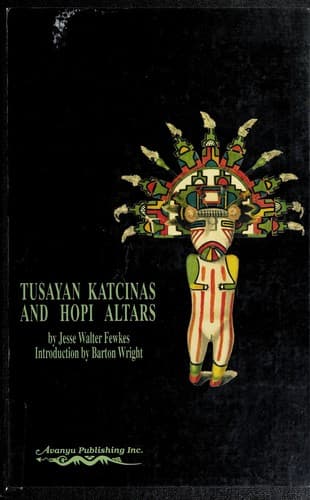
The second group, called the Katcinas, which may be divided into two
smaller divisions, known as the elaborate and the abbreviated, fills
out the sequence of religious ceremonials between the Soyáluña and the
Nimánkatcina. These celebrations are distinguished from those of the
former group by the presence of masked personages to whom is given the
name of Katcinas. By the use of these masks or helmets the participant
is supposed to be transformed into the deity represented, and women and
children avoid looking at Katcinas when unmasked. The main symbolism of
the deity is depicted on the helmet or head, and varies in different
presentations, but the remaining paraphernalia is constant, whatever
personage is represented.[26]
The mask (kü′ĭtü, head) is often addressed as íkwatci, “my friend
or double.” Prescriptively it must be put on and taken off with the
left hand.[27] It is of helmet shape, fitting closely to the head and
resting on the shoulders. These masks or helmets are repainted at
each presentation with the symbolism of the personage intended to be
represented. They are ordinarily made of leather, portions of boot legs
or saddles, and in one or two instances I have found on their inside
the embossed or incised markings characteristic of Spanish saddles. Old
felt hats are sometimes used in the manufacture of the simpler masks
and those of the mud-heads are of coarse cloth. Few of the helmets now
used give evidence of very great antiquity, although some are made of
the skin of the bison. One can seldom purchase these helmets, as their
manufacture is difficult, and instead of being discarded after use in
one ceremony they are repainted for other presentations.
There is a similar uniformity year by year in the time of the
celebration of the extended or elaborate Katcinas called Nimán,
Powámû, Pálülükoñti, Soyáluña, and the Pa or Katcina’s return. Their
sequence is always the same, but in the abbreviated Katcinas or masked
dances this uniformity is not adhered to. A certain number of these
are celebrated each spring and summer, but the particular abbreviated
Katcina[28] which is presented varies from year to year, and may or may
not be reproduced.
While Katcinas or masked dances do not generally occur during the
interval of the nine days’ ceremonials (autumn and early winter), I
have notes on one of these which indicate that they sometimes take
place in this epoch.
On September 20, 1893, a Katcina called Áñakatcina[29] was performed
in Hano after the Nimán had been celebrated in Walpi. Theoretically it
would not be expected, as the farewell Katcina is universally said to
be a celebration of the departure of these personages to their distant
home, an event which does not occur at Hano. It would be strange if
later observations should show that Katcinas are celebrated in other
villages between the departure and return of these personages.
DISCUSSION OF PREVIOUS DESCRIPTIONS OF KATCINAS
Public-domain text, read in full here on John Shaqi.
Reviews
Reviews
No reviews yet
Be the first to share your thoughts on this work.
Join the Discussion
Join the discussion
Sign in to leave a comment or review.
Sign InorCreate an account