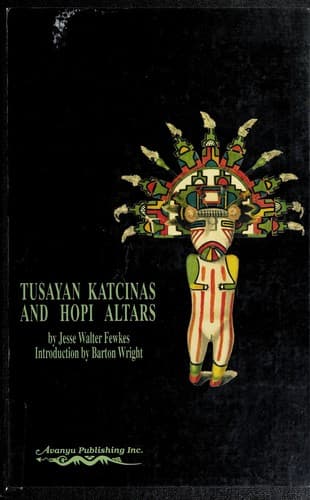
The Shálako is one of the most important observances at Zuñi, and is
partially described by Cushing in an article on his life in Zuñi.[96]
An exhaustive account, however, has never been published. The Hopi
occasionally celebrate a Cálako, which from its name and other reasons
is undoubtedly an incorporated modification of this ceremonial, as
the Tusayan legends distinctly state.[97] The following pages give an
outline of the Hopi presentation as a contribution to the comparative
study of Pueblo ritual. A complete account of the Shálako at Zuñi is a
great desideratum before it is possible to undertake close comparisons.
The presentation of Cálako is not an annual event at the East mesa of
Tusayan, but occurs after long intervals of time. The paraphernalia are
kept in a house in Sitcomovi and belong to the Badger clan. The house
in which they are deposited is the property of Koĭkáamü, the daughter
of Masiúmtiwa’s eldest sister, now deceased, and the wími likewise
belong to her by descent.
The chiefs of all the gentes in Walpi and Sitcomovi, the chief of the
Katcinas, and one or two others from Hano assembled in this house on
the 16th of July, 1893, and made a large number (over two hundred) of
páhos for use in the ceremonials to be described.
Early on the morning of the next day the masks and effigies of
Siocálako were renovated and carried to the spring called Kwañwába
(sweet water), which is situated on the Zuñi trail southward from
the mesa. In a modern house owned by a Sitcomovi family[98] at this
spring the masks were repainted and the hoops which were used to make a
framework for the bodies were set around with eagle feathers.
The effigies which were used in personifications were made up of masks
or helmets of the ordinary size for the heads and a crinoline-like[99]
framework of willow hoops for the bodies. These masks were made from
narrow shreds of leaves of the agave plaited together diagonally, and
this plaited frame was covered with a painted buckskin upon which the
symbolism of the Síocálako was delineated. The projecting beak of the
face had a movable under jaw, which was hinged and manipulated with
a string. The helmet was attached to a staff forming a backbone, 3½
feet long, by which it was carried. The series of crinoline hoops or
supports of the blankets which formed the body were about fifteen in
number, the upper being about the size of the helmet, the lower 4½ feet
in diameter. A tü′ihi or large white embroidered mantle was draped
about the upper hoops or the shoulders, and a gray fox-skin was hung
around the neck, which was likewise profusely decorated with shell
necklaces.
The man who acted the part of bearer walked inside the crinoline,
freely supporting the effigy by the staff or backbone, holding it at
such a height as to permit the lowest hoop with its attached feathers
to reach to his knees. Each effigy bearer was bareheaded, and although
hidden from view, was decorated with the white kilt of a typical
Katcina.
Public-domain text, read in full here on John Shaqi.
Reviews
Reviews
No reviews yet
Be the first to share your thoughts on this work.
Join the Discussion
Join the discussion
Sign in to leave a comment or review.
Sign InorCreate an account