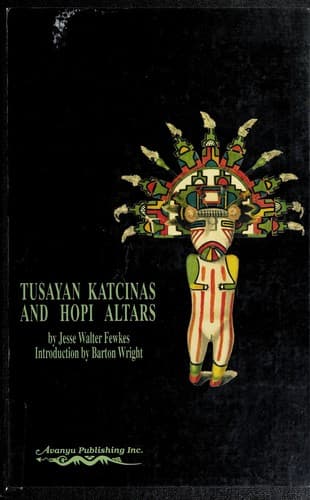
At the conclusion of this observance in the plaza the four giants were
conducted by the chiefs of the Lizard, Ása, Badger, and Water gentes
to the houses of the elder sisters of the respective clans. The Cálako
effigies were suspended by the mask from the rafters of each room, and
as the length of each was 7 feet 6 inches the tips of the radiating
feathers on the head and those on the last hoop of the framework of the
body just touched the roof and floor of the chamber. The same ceremony
look place in each house and there were prayers by the elders, dancing
by the effigy bearers, and singing and drumming by the “Koyímse.” At
sunrise—for the exhibitions in the houses lasted all night—a final
presentation in the court similar to that which opened the ceremonies
took place, after which the Cálakos and mud-heads went to the cliff and
unmasked at the Kachinaki. There they performed purification ceremonies
(navótciwa) and dismantled the effigies. They donned their ordinary
habiliments and smuggled the paraphernalia back into the chamber in
Sitcomovi, where it is ordinarily kept.
[Illustration: FIG. 42—Position of celebrants in the court of Sitcomovi
in Síocálako.[102]]
On the 8th and 9th of the month, following the demise of the Cálakos, a
most elaborate Wáwac or Racing Katcina was performed.[103]
PAWÍKKATCINA
The Pawíkkatcina, which I observed at Sitcomovi in 1892, had certain
differences from any abbreviated Katcina dance which I have yet
described, and illustrated the ceremonial reception of these personages
after they had visited another pueblo. A priest of Sitcomovi suggested
that his fellow villagers should send a delegation of young men to
Cipaulovi to return a dance with which they had previously been honored
by the latter pueblo. Accordingly the masks were painted and the
preliminary ceremonials took place in one of the Sitcomovi kivas, those
who were to participate in the ceremonial beginning their work on the
25th of June. The visitors danced all day of the 27th at Cipaulovi,
rested on the 28th, and continued their dance on the 29th at Sitcomovi.
The ceremonials on their return at the trail approaching Sitcomovi took
place on June 28th, an hour before sunset.
[Illustration: FIG. 43—Mask of Pawíkkatcina (front view).]
This dance differed very little from that of other Katcinas, to which
attention has hitherto been directed.[104] There were twenty-three
Katcinas and five[105] Katcinamanas, and the masks of both are
illustrated in figures 43, 44, and 45, while one of the staffs which
they bore is represented in figure 46. They sang five songs called
Ómowûh (cloud), Yoivíkka (swift), Pakwa (frog), Pawykia (duck), and
Patzro (quail). An interesting feature which I had never before seen in
Tusayan abbreviated Katcinas was the unmasked dance in the kiva.[106]
Public-domain text, read in full here on John Shaqi.
Reviews
Reviews
No reviews yet
Be the first to share your thoughts on this work.
Join the Discussion
Join the discussion
Sign in to leave a comment or review.
Sign InorCreate an account